You're creating content, posting your work, sharing behind-the-scenes glimpses, writing captions…
Maybe even making videos, sending emails, or experimenting with AI.
And yet, your creative business isn't really growing. 😬
Your audience isn't engaging the way you'd hoped.
You're not getting a steady stream of inquiries.
Your content feels disconnected from your business goals.
And whenever you sit down to plan the next piece, you're essentially guessing what might work.
The real problem?
You don't have a content system. You have a content guessing game.
And guessing is exhausting because every post becomes an experiment with no clear connection to the next one.
In this blog, I'm breaking down why so many arts entrepreneurs get stuck in this cycle and the 4-step content framework I teach inside my coaching to help creatives build a more intentional, sustainable approach to content—with AI supporting the process, not replacing their creative voice.
You'll learn how to stop creating content simply for its sake and start giving it real purpose.
🎥 Prefer to watch? I explain this exact problem in my YouTube video as well:
Table of Contents
Why Most Creative Content Doesn't Lead to Growth
Let's start with an uncomfortable question:
Is your content designed to grow your business?
Not just to get likes, fill your Instagram grid, or prove that you're active online.
I'm talking about content that helps the right people:
Discover you.
Understand what you do.
Trust your expertise.
Stay connected to you.
Take the next step toward working with or buying from you.
That's a very different job—one that many creative entrepreneurs never explicitly give their content.
Instead, content creation is often reactive.
You make something when you have an idea, post when you have time, jump on a trend because everyone else is doing it, or try a new platform because someone told you that's where the growth is.
Then you look at the results and wonder why nothing seems to be happening (sounds familiar?).
This isn't because your content is bad, but because individual pieces of content don't create a strategy by themselves.
Stats support this distinction, showing how top-performing marketers attribute their success to understanding their audience (82%), producing high-quality content (77%), and having industry expertise (70%).
They also point to aligning content goals with organizational objectives (62%) and effectively measuring performance (53%).
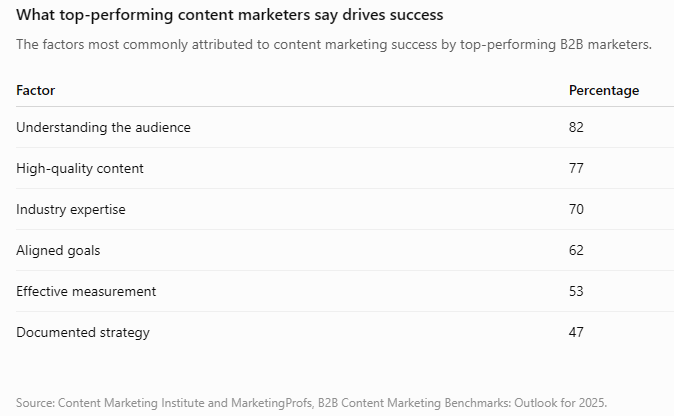
Notice what's missing from the top of that list?
The strongest content plans aren't successful because they produce a lot.
They're successful because the content has a clear objective.
Which brings us to the real growth killer…
The Difference Between Content Guessing and a Content System
Here's what content guessing looks like:
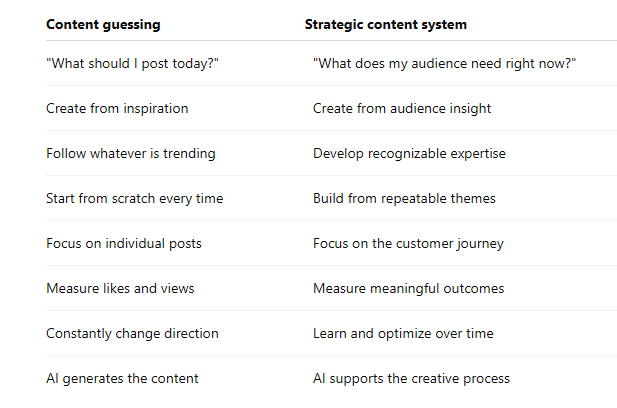
The difference isn't just organization. It's intentionality.
With a guessing game, every post exists in isolation.
With a system, content has a job.
Some content helps people discover you; some teaches them a key lesson; some proves your expertise; some builds trust and moves people toward your offer; and some keeps your existing audience engaged until they're ready to take the next step.
That's how content starts compounding!
Why more content isn't necessarily the answer
We're living through an enormous increase in content production.
AI has made it easier than ever to generate countless variations of blogs, social posts, emails, videos, images, you name it.
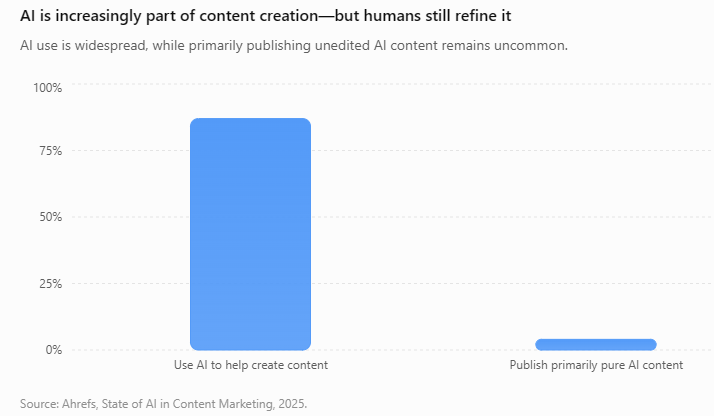
87% of companies use AI to help create content, with a median of 17 articles published per month compared to 12 among companies not using AI—that’s an impressive 42% difference.
But there's a catch.
If everyone produces more content, volume becomes less differentiating.
Sprout Social's 2025 Content Benchmarks research analyzed more than 3 billion messages from over 1 million public social profiles and concluded that social content saturation is at an all-time high.
Its main takeaway is straightforward: Merely posting isn't enough to capture attention.
So if your response to slow growth is: "I just need to post more."
…You may be solving the wrong problem.
You don't need more content; you need content that works together with your goals!
The 4-Step Content Framework for Intentional Growth
This is the framework I teach my coaching clients to help them move from random content creation to a more intentional system.
Think of it as a cycle rather than a straight line:
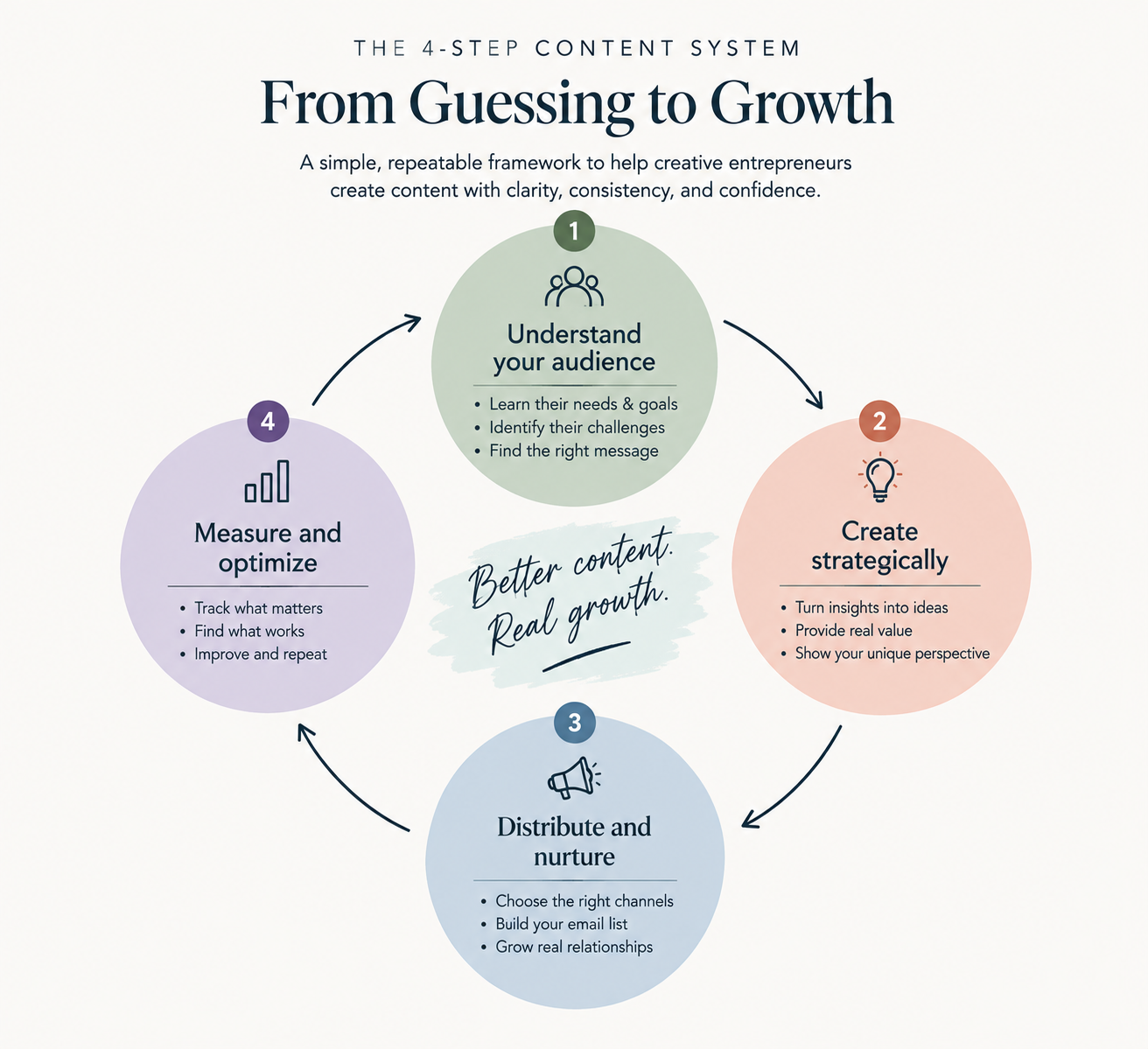
Let's break it down.
Step 1: Understand your audience
Everything starts here.
Before you decide what to post, you need to know WHO you're trying to reach and what they actually care about.
And I'm not talking about creating a generic ideal-client avatar with a name, age, favorite coffee order, and Pinterest board (LOL).
I mean understanding the problems and desires that shape their decisions.
Ask yourself:
What are they struggling with?
What are they trying to achieve?
What have they already tried?
What frustrates them?
What questions do they repeatedly ask?
What misconceptions do they have?
What might stop them from buying?
What would make them trust someone like you?
This is where audience research becomes incredibly valuable.
Imagine you're an artist selling original work.
You might initially think your content needs to be about: "How I made this painting."
But audience research could reveal that potential collectors are actually struggling with:
"How do I know if an original artwork is worth investing in?"
That's a completely different content opportunity.
Or perhaps you're an independent museum professional offering consulting services.
You might think your audience wants: "Social media tips for museums."
But after talking to museums, you discover they're actually struggling with:
"How can we create meaningful digital content when our team is already stretched thin?"
Now you have a much stronger starting point.
This is why understanding your audience is vital to business success—it sets the foundation for effective content strategy.
Step 2: Create content around what your audience needs
Once you’re crystal-clear on your audience, it’s time to create content that meets their specific needs.
This is where you move from "What do I want to say?" to "What does my audience need to hear from me?"
That doesn't mean you have to abandon your personality, opinions, or creative perspective.
Quite the opposite!
Your unique perspective makes the content yours.
But now you're connecting that perspective to something your audience truly cares about.
A useful way to think about your content is through different roles.
You might create content that:
Educates: Teach your audience something useful.
Challenges: Question an assumption or introduce a new perspective.
Inspires: Show what's possible and achievable.
Builds trust: Share your experience, process, stories, and results.
Demonstrates expertise: Show people how you think about problems.
Converts: Help someone understand why your offer could solve their problem.
Not every post needs to do all six (that's another common content mistake).
One post doesn't have to educate, entertain, tell your life story, sell your offer, build community, and drive sales at the same time.
Give each piece a distinct job.
Step 3: Distribute your content and build relationships
Creating excellent content isn't enough.
People have to see it.
That's where distribution comes in—not by being everywhere, but by intentionally choosing the channels where your audience is most likely to find and engage with you.
More importantly, where they’re already looking for solutions to their problems.
For one creative entrepreneur, that might be YouTube + email; for another, blog + Instagram + email, or LinkedIn + newsletter.
The right combination depends on your audience, goals, strengths, and capacity.
Mind you, though, your content shouldn't exist only on a rented platform.
That’s where building an email list becomes an essential part of a strong creative business's content system.
Social platforms help people discover you.
But your email list gives you a more direct way to continue the relationship with a simple progression:
Discover → Follow → Subscribe → Trust → Buy
Not everyone will move through those stages immediately, and that's okay (I’ve seen this in my business too!).
Content marketing isn't about convincing someone to buy the first time they encounter you.
It's about giving the right-fit people enough valuable, relevant experiences with your brand that choosing you eventually feels natural.
Step 4: Measure, learn, and optimize
This is the step many creatives skip.
You publish something, check the likes, and move on.
But if you don’t look at what your audience responds to, you're leaving precious information on the table.
Measurement doesn't mean obsessing over vanity metrics (at all!).
It means asking:
What topics consistently attract my target audience?
Which pieces generate meaningful conversations?
What sends people to my website?
What content leads to email subscribers?
What content gets mentioned in sales conversations?
Which offers are people clicking on?
What questions keep coming up?
What isn't working?
And then you use those insights to make better decisions about what to create next.
That's how your content system becomes smarter over time.
You stop guessing, learn what moves the needle for you (or what doesn’t), and finally recognize patterns.
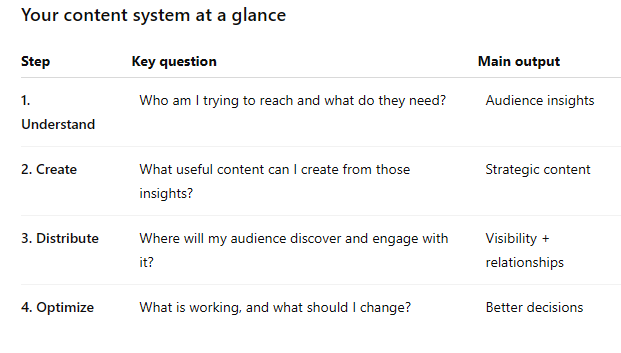
Then you repeat those steps, as your content strategy isn't something you "finish,” but an ongoing feedback loop.
Where AI Fits Into Your Content System
AI doesn't replace these four steps. It supports them.
How?
You don't want AI to decide who your audience is, what your brand believes, or what your creative business should stand for (that’s your task!).
But it can make almost every stage of the workflow more efficient.
During audience research
AI can help you organize interview notes, identify recurring themes in customer feedback, categorize questions, and surface patterns you might have missed.
You still need human judgment to interpret those patterns, but the groundwork is 10x faster and more effective this way.
During content creation
AI can help you:
Brainstorm angles.
Turn audience problems into content ideas.
Build outlines.
Develop examples.
Repurpose long-form content.
Improve clarity.
Identify gaps.
Generate variations.
Brainstorming (76%), outlining (73%), and content updates (67%) are among the most common AI-assisted content tasks for a reason.
It’s not about telling AI to write an entire random article for you, but using it for thinking-support tasks that take you from a rough idea to a stronger finished piece.
That’s what it’s worth using for!
During distribution
AI can also adapt one core idea for different channels:
One YouTube video becomes a newsletter.
The newsletter becomes a LinkedIn post.
The video generates several short-form ideas.
The core lesson turns into a blog section.
The audience questions inspire future videos.
The possibilities are endless, and the best part is you're not creating five separate ideas.
You're distributing one strong idea in multiple useful ways that amplify your impact.
During measurement
AI can organize content performance data, identify recurring themes, compare content categories, and turn a messy analytics export into something easier to interpret.
But again, the goal isn't to let AI tell you what to do blindly.
Use it to accelerate analysis and simplify the overall process.
Then apply your own strategic judgment to make wiser decisions.
The human + AI content system
The healthiest marketing workflow looks something like this:
You bring expertise, perspective, audience understanding, and creative direction.
AI helps with brainstorming, organization, analysis, repurposing, and efficiency.
You then refine the AI work by editing, fact-checking, adding nuance, and making smarter decisions.
This human-in-the-loop approach is key to making the AI-generated content authentic.
You move from: AI → content → publish
To: Human insight → AI assistance → human refinement → helpful content → audience feedback → better insight
That's a system that works and generates lasting results!
Want to make AI part of your content system?
If you're a creative entrepreneur who knows AI could save you time but doesn't want your content to lose your voice, I've created a free guide for you: “5 AI-Powered Solutions for Creatives Who Dread Marketing.”
It gives you practical ways to use AI for content creation without handing over your creativity to a machine.
Get your copy here: “5 AI-Powered Solutions for Creatives Who Dread Marketing.”

What Actually Moves the Needle Online?
At this point, you might be wondering: “Okay, but what actually makes content lead to growth?”
There isn't one magic metric or platform, but a few things consistently count
1. Relevance
Your content needs to matter to the people you're trying to reach.
This is why audience research comes first.
If your audience doesn't care about the problem you're solving, better hooks won't save the content.
2. Expertise
You need something worth saying.
Your experience as an artist, designer, curator, museum professional, or creative entrepreneur is an advantage.
Don't hide it behind generic language.
Share what you know.
Show how you think.
Teach people something they couldn't get from a thousand impersonal AI-written posts.
Google itself emphasizes people-first content and asks whether content provides original information, research, analysis, or substantial value instead of being created to manipulate rankings.
Your expertise and POV are crucial!
3. Consistency
Not constant posting. Consistency.
There's a difference.
You want your audience to find your ideas often enough that they become familiar and relevant.
That could mean one excellent blog a week, or eight valuable social posts a month.
Whatever the case, your ideal cadence depends on your business goals and creative rhythm—so be mindful!
4. Distribution
Even brilliant content can't help your business if nobody sees it.
That's why distribution (aka a smart choice of where to be online with your content) belongs inside the system—not as an afterthought.
5. Relationships
People rarely buy creative work or services because of one random post.
They buy because trust develops over time:
They recognize your name.
They understand your perspective.
They see evidence of your expertise.
They believe you understand their problem.
They come back for more of your support.
To make this happen, adopt content as relationship-building rather than attention-seeking.
It’ll pay dividends!
6. Learning
Not gonna lie: Your first strategy won't be perfect; it doesn't need to be (I learned this the hard way!).
The point of having a content system is that you learn from what happens and make the next iteration better.
That's far more powerful than endlessly searching for the perfect content formula.
Here’s what moves the needle vs. what keeps you “busy”:
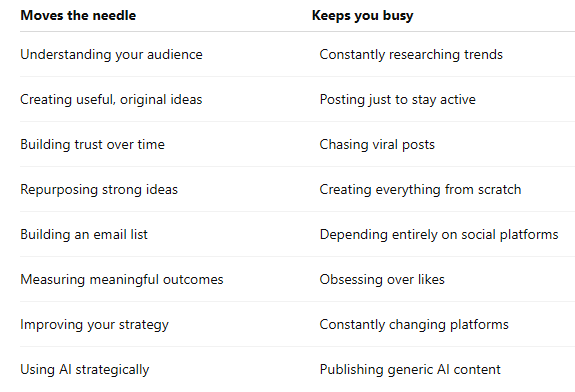
The distinction is simple:
Activity isn't the same as progress.
You can be incredibly busy with content and still not building an audience, trust, or demand for your work.
So instead of getting stuck in a pointless hamster wheel, make the most of your efforts with a sustainable system that supports YOU.
FAQs - Content Systems for Creatives
What is a content system?
A content system is a repeatable process for planning, creating, distributing, and evaluating content based on your audience and business goals.
Instead of deciding what to post from scratch every time, you have a purposeful framework that guides your decisions.
Why isn't my content leading to business growth?
There are several possible reasons, but one common problem is that your content isn't connected to a clear strategy.
You may be creating content that gets attention without attracting the proper audience, educating people without leading them toward your offer, or posting consistently without learning from the results.
The first step is to identify who you want to reach, what they need, and what role your content should play in your customer journey.
How much content do I need to create to grow?
There's no magic number.
More content isn't automatically better (social content saturation is real!), so focus instead on creating helpful, solution-driven content at a pace that your business can sustain.
Should I use AI to create my content?
Yes—but strategically.
AI is useful for brainstorming, outlining, repurposing, organizing research, analyzing information, and speeding up repetitive tasks.
But your expertise and perspective should remain at the center of the content. Always.
Can AI replace my content strategy?
No. AI can execute parts of your strategy, but it can't replace your understanding of your audience, your creative perspective, your business goals, or your judgment.
The strongest AI-supported content workflows combine human expertise with AI efficiency.
Do I need to be on every social media platform?
Absolutely not.
Choose the channels where your audience actively searches for help and where you can realistically deliver quality content.
Being excellent on two channels is more useful than being mediocre on five.
What should I measure if likes and followers aren't the goal?
Look at metrics connected to your actual business objectives.
Depending on your strategy, that could include website traffic, email subscribers, inquiries, qualified leads, sales, content-assisted conversions, meaningful replies, or recurring engagement from the right audience.
The metric isn't the goal—the business outcome is!
Stop Guessing. Start Building a System.
If your creative business feels stuck online, your first instinct might be to create more.
More posts, more videos, more reels, more platforms, and even more AI.
But “more” isn't the answer!
You need to know WHY you're creating content before determining how much content you need.
That's why I teach a four-step content system inside my coaching:
Understand your audience.
Create strategically.
Distribute and nurture.
Measure and optimize.
Then you repeat.
The beauty of it is that you don't have to guess your way forward anymore.
You have a process.
You have feedback.
You have a deeper understanding of what your audience needs.
And you can implement AI to make the process faster, lighter, and more efficient.
Remember: Your creative business doesn't need more random content.
It needs content that works towards your unique purpose.
Start there! 😉
If you're ready to build that kind of system around your business, Content Clarity & Flow is my coaching program designed to help creative entrepreneurs, especially visual artists and independent museum professionals, clarify their marketing, develop an intentional content strategy, and create a sustainable workflow that supports growth without pulling them away from their creative work.
Explore all about the program here: "Content Clarity & Flow"