Why “Be Everywhere” Is Killing Your Marketing
If you’re a creative entrepreneur trying to grow your brand online, chances are you’ve heard some version of this advice:
“You need to post everywhere.”
“Be on every platform.”
“Repurpose everything across Instagram, TikTok, Pinterest, LinkedIn, Threads, YouTube, Facebook…”
And honestly?
That pressure is exhausting. 😣
For many artists, designers, illustrators, makers, photographers, museum professionals, and creative business owners, maintaining a presence on every platform doesn’t lead to more growth—it leads to burnout, inconsistency, and creative paralysis.
Instead of helping your marketing, it slowly drains the energy you need to deliver meaningful work and connect with your dream audience.
Sustainable visibility isn’t built through constant platform-hopping.
It’s built through clarity, intentionality, and consistency.
In today’s post, we’ll break down:
Why the “be everywhere” advice is hurting creatives like you.
How to choose the right platform(s) for your artsy business.
Real examples of focused marketing in action.
A simple step to immediately simplify your strategy.
Why focusing on 1–2 platforms generates better long-term growth than trying to do everything at once.
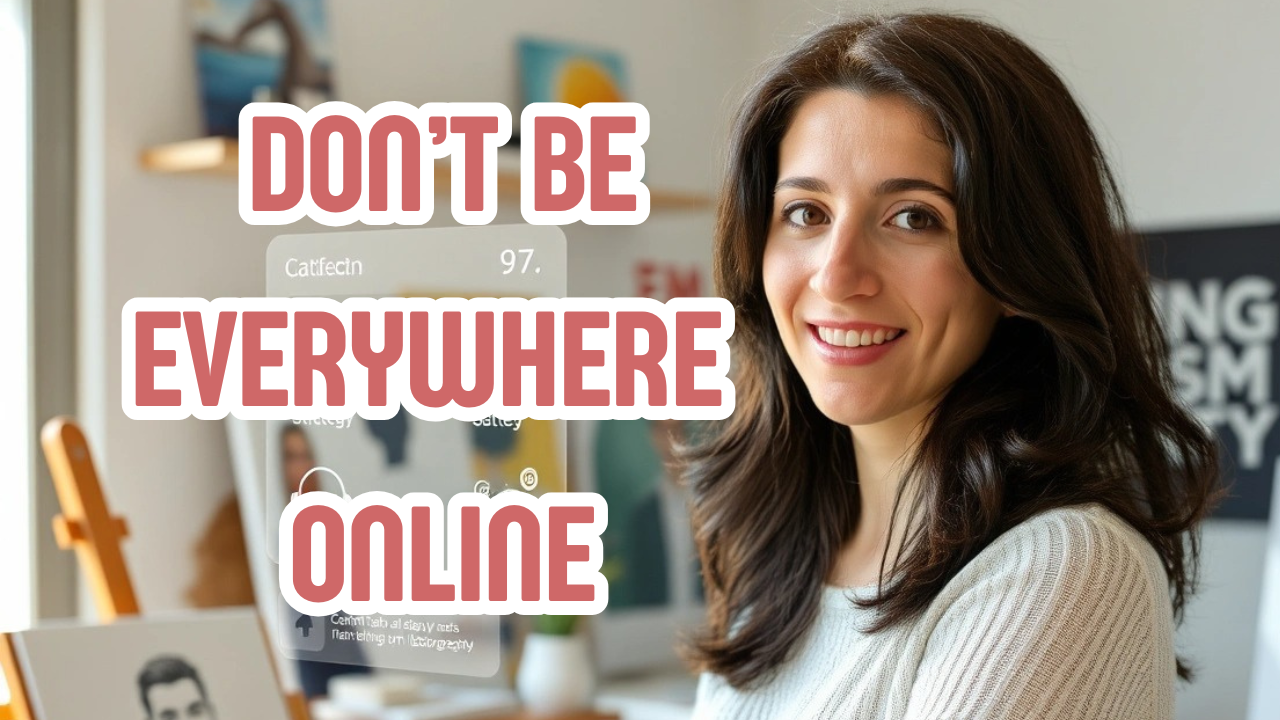
And if you’d rather watch the conversation first, check out my YouTube video on this topic here:
The Hidden Cost of Trying to Be Everywhere
At first glance, posting on every platform sounds smart.
More platforms = more visibility… right?
Not necessarily.
What actually happens is:
You spend more time managing content than focusing on your own work.
Your messaging becomes inconsistent.
You constantly switch between trends, formats, and algorithms.
You feel behind all the time.
Your creative energy gets fragmented

What happens when creatives try to market on every platform at once.
Instead of building momentum, you build overwhelm.
And the data around creator burnout is becoming harder to ignore.
A report from Later found that 49% of creators experience high levels of social media burnout.
Another study reported that 52% of creators have experienced burnout directly tied to content creation demands, with 37% considering leaving the industry entirely.
That’s not a sustainable business model if you constantly juggle your work, client projects, commissions, products, admin work, and life outside of social media.
And honestly, “more platforms” isn’t the solution to this common struggle.
What you need is a clearer strategy that supports your brand sustainably in the long run.
More Platforms Don’t Automatically Mean Better Marketing
This is where many creatives get stuck.
They assume that if someone else is growing on TikTok, YouTube, Instagram, LinkedIn, and Pinterest simultaneously, they should be doing the same.
But what you don’t always see is:
The team behind the scenes.
Years of existing audience trust.
Outsourced editing or management.
Massive content libraries to repurpose.
Full-time schedules dedicated entirely to content.
Trying to replicate that as a solo creative entrepreneur (I know this firsthand!) often builds unrealistic expectations.
And ironically, being everywhere can dilute your brand presence and impact.
When your energy is scattered across multiple platforms, it becomes harder to:
Create intentional content.
Build recognizable messaging.
Nurture community.
Maintain consistency.
Stay creatively inspired.
You end up reacting instead of strategically communicating—making your brand even more fragmented!
The Best Platform for Your Creative Business Depends on How You Naturally Communicate
One of the biggest mistakes creatives make is choosing platforms based purely on trends rather than their communication strengths.
For example:
If you naturally enjoy long-form storytelling and teaching, YouTube or LinkedIn may feel more aligned.
If your work is highly visual and process-driven, Instagram or Pinterest might better match your brand.
If you enjoy fast-paced conversational content, TikTok may fit your personality and workflow.
If you prefer depth over constant posting, email marketing may become your strongest long-term asset.
You don’t have to force yourself into platforms that constantly drain you.
The real goal is to identify where:
Your audience already spends time and consumes content.
Your creative communication style feels sustainable.
You can realistically stay consistent.

Sustainability is key to a healthy creative business.
So, before committing to any platform, ask yourself:
Do I actually enjoy creating content there?
Does my ideal audience look for help there?
Can I consistently show up?
Does this platform support my business model and goals?
Does creating for this platform energize or drain me?
Your answers will matter more than any trends or generic recommendations.
Why Focus Creates Better Creative Flow
The moment you simplify your marketing ecosystem, you gain immediate clarity and confidence in showing up online.
I’ve seen this happening repeatedly while working with creative entrepreneurs.
Why?
Because fewer platforms mean:
Fewer decisions.
Fewer content formats.
Less algorithm anxiety.
More intentional messaging.
Deeper audience connection.
More time for actual creative work.
And that mental space changes everything!
Research around information overload shows that constant streams of content and platform demands reduce people’s ability to process information effectively.
Even worse, social media fatigue impairs productivity and task completion over time—something creatives experience often.
You don’t just focus on your creative work anymore.
You’re also expected to strategize, film, edit, write captions, optimize hooks, track analytics, monitor trends, and stay consistent everywhere.
At some point, this flawed system will collapse.
That’s why easing your marketing strategy is key!
Real Examples of Platform Focus in Action
Let’s look at what intentional platform focus means in practice…
Example 1: The Visual Artist Focused on Instagram + Email
Instead of trying to master every platform, a visual artist may focus primarily on:
Instagram for visibility and community.
Email marketing for nurturing collectors and buyers.
Their strategy becomes much simpler as they:
Share their studio process.
Showcase finished work.
Document artistic evolution.
Prioritize storytelling and community interaction.
Drive followers to an email list for stronger client relationships.
This creates a clear ecosystem instead of fragmented content chaos.
Example 2: The Creative Educator Using YouTube + LinkedIn
A creative educator who enjoys teaching may focus on:
YouTube for searchable long-form authority content.
LinkedIn for thought leadership and relationship-building.
One core idea becomes a high-value weekly YouTube video, a LinkedIn post, and even a newsletter topic, rather than dozens of scattered Instagram or TikTok posts.
That’s strategic repurposing—not spreading yourself thin everywhere.
Example 3: The Maker Choosing Pinterest Over Trend-Based Platforms
A product-based creative business may decide to prioritize Pinterest because:
The content has a longer lifespan there.
Discovery is search-driven.
Visuals perform well over time and boost visibility.
That’s a smarter use of energy that doesn’t force daily short-form video creation misaligned with their brand.
In other words, they don’t simply choose the “best” platform.
They choose the best platform for them!
A Quick Step to Simplify Your Marketing Today
If your marketing feels overwhelming, I recommend this simple exercise…
Step 1: List Every Platform You’re Currently Using
Write them all down.
Be honest.
Step 2: Circle the Platforms That Actually Produce Results
Not vanity metrics.
Real results like:
Sales.
Inquiries.
Engagement.
Email subscribers.
Community growth.
Collaborations.
Step 3: Ask Yourself Which Platforms Feel Sustainable
Not exciting for one week, or trending.
Identify sustainable platforms that fully meet your strengths, brand personality, communication style, energy, consistency, and target audience.
Step 4: Choose 1–2 Core Platforms
Then choose:
One primary platform as your main visibility channel.
One secondary support platform for nurturing, community, and discoverability.
Focus your content energy there over the next 90 days to test, track performance, and refine your strategy accordingly.
This shift will create intentional focus, while dramatically reducing marketing fatigue!
If Marketing Feels Heavy, You Don’t Need More Pressure—You Need Better Systems
Don’t assume you’re failing at marketing because you’re not doing enough.
That’s not the issue.
The issue is keeping systems that were never designed for sustainable creativity in the first place.
My strong advocacy for intentional, AI-assisted content workflows comes as no surprise here—to maximize your efforts.
When trained well, AI can reduce the mental load that keeps you stuck in a state of overwhelm.
From brainstorming topic ideas to drafting content formats aligned to your needs, it automates repetitive tasks and carries the heavy lifting of content creation for you!
The constant need for “more content” to grow ends, making space for clearer messaging, stronger strategy, and sustainable consistency.
And that’s what simplified marketing is all about!
Is your marketing feeling overwhelming, inconsistent, or creatively draining lately?
My free guide, “5 AI-Powered Solutions for Creatives Who Dread Marketing,” will show you how to use AI strategically to simplify your content process without losing your voice.
Inside, you’ll learn:
How to reduce content overwhelm
Ways AI can support creative marketing workflows
Smarter content planning strategies
How to stay visible without burning out
Grab your copy here: “5 AI-Powered Solutions for Creatives Who Dread Marketing.”

FAQs - Social Media Strategy for Creative Entrepreneurs
Do creatives really need to be on every social media platform?
No. Most creative entrepreneurs grow more sustainably when they focus on 1–2 platforms that align with their communication style, audience, and energy capacity. Being on every platform often leads to burnout, inconsistency, and diluted messaging.
What is the best social media platform for artists and creatives?
The best platform depends on your goals, audience, and content strengths.
For example:
Instagram works well for highly visual creatives.
YouTube is strong for educational and long-form content.
LinkedIn supports thought leadership and relationship-building.
Pinterest is useful for evergreen visual discovery.
The “best” platform is usually the one you can keep consistently without sacrificing your creative flow.
Why does social media marketing feel so overwhelming for creatives?
Many creatives juggle too many platforms, trends, and content formats at once. Constant visibility pressure creates decision fatigue and creative burnout, but simplifying your marketing ecosystem will improve clarity and consistency.
Is it better to focus on one platform or repurpose content everywhere?
Strategic repurposing can absolutely help, but that’s different from trying to actively manage every platform equally.
A healthier approach is:
One primary platform for visibility.
One secondary platform for nurturing or support (a newsletter is a great option here).
Intentional repurposing from a core content ecosystem.
This creates sustainability over ongoing content pressure.
How can AI help creative entrepreneurs with marketing?
AI can support creatives by helping with:
Brainstorming content ideas.
Repurposing long-form content.
Organizing messaging.
Simplifying workflows.
Reducing content creation overwhelm.
The goal isn’t to replace creativity—it’s to reduce the mental load and gain time and energy to reinvest into your meaningful work.
Sustainable Marketing Is Built Through Clarity, Not Constant Hustle
The internet will keep telling you to do more.
More content.
More platforms.
More trends.
More visibility hacks.
Don’t fall for it!
Sustainable marketing growth rarely comes from doing everything or being everywhere.
It comes from:
Clear messaging.
Intentional content.
Strategic platform focus.
Repeatable systems.
Consistency you can carry forward.
Most importantly, it comes from protecting your creative energy so you can enjoy your business again!
If growing online without burnout is your purpose, do the right things consistently and intentionally.
And choose focus over fragmentation.
Because successful creative brands aren’t everywhere; they’re aligned. 😉
Ready for personalized support?
If you’re a creative entrepreneur who feels overwhelmed trying to market your work online, my 1:1 coaching program, Content Clarity & Flow, is designed specifically to help creatives build a simpler, more aligned approach to content marketing for long-term growth.
Inside the program, we work together to:
Clarify your messaging and audience.
Build a realistic content strategy tailored to your brand.
Streamline your marketing systems.
Integrate AI intentionally and ethically.
Amplify sustainable visibility without burnout.
Develop a marketing ecosystem that supports your creative flow without disrupting it.
So you’ll finally market your creative business with more clarity, confidence, and ease!