Do you ever sit down to create content for your creative business and suddenly have no idea what to say? 😖
Maybe you're worried about what the algorithm wants.
Maybe you wonder how often you're supposed to post.
Maybe you're unsure who you're creating for.
Or perhaps you've heard that you should be using AI, but the thought of adding another tool to your workflow makes you cringe.
If this sounds familiar, you're not bad at content.
You may simply be caught in a common content trap:
Trying to create more content without having enough clarity about why you're creating it, who it's for, or how it connects to your business.
In this article, we'll look at why content marketing feels particularly overwhelming for creative professionals—and, more importantly, how to build a simpler approach that helps you create with more clarity, consistency, and confidence.
🎥 Prefer to watch? I explore this topic in my YouTube video as well:
Table of Contents
Why Do Creative Professionals Struggle With Content?
Creative professionals are usually very good at creating.
Artists create artworks.
Designers solve problems.
Curators tell stories and build connections between objects, ideas, and audiences.
Museum professionals educate and engage communities.
But content marketing asks you to use a completely different creative muscle.
You're not only creating something interesting.
You're communicating the value of what you do to a specific audience, often with a specific business goal in mind.
That's where many creative entrepreneurs get stuck…
You might be incredibly knowledgeable about your craft but still find yourself staring at a blank content calendar thinking:
"What am I supposed to post?"

This question, though, starts too far downstream.
Because before choosing what to post, you need to know:
Who are you trying to reach?
What do they need help with?
What do you want to be known for?
What role should your content play in your business?
Without those answers, every post becomes a brand-new decision.
And when you're already running a creative business, constantly making those decisions is exhausting.
This feels so difficult for one reason…
Today's content environment rewards constant visibility, while audiences are becoming increasingly selective about what deserves their attention.
94% of social practitioners feel they need to be "chronically online" to do their jobs, while more than one-third feel creative fatigue has increased compared with the previous year. At the same time, 93% believe AI could help combat creative fatigue.
That's a pretty good recipe for burnout, right?
The answer isn't to become “better” at producing more content, rather to STOP treating content creation as an endless production line.
The 5 Traps Keeping Creatives Stuck
Let's look at the most common patterns that create content overwhelm—and what to do instead.
1. The "What Should I Post?" Trap
One of the biggest mistakes is starting every content piece with a blank page.
Every week, you sit down wondering: "What should I post?"
Then you search for ideas, look at what other people are doing, check the latest trends, scroll through social media for inspiration…
And eventually, you end up either copying what's already out there or posting something generic because you're running out of time.
The problem isn't that you don't have ideas.
It's that you don't have a system to capture and organize them.
But guess what, your content ideas are probably already hiding in your business!
Think about the questions clients ask you.
The mistakes you've made.
The things you wish your audience understood.
The misconceptions you encounter.
The processes you use.
The opinions you have about your industry.
Or the transformations you've helped create.
These are all potential content.
Instead of inventing a completely new topic every time, start building a content idea bank around what you already know.
From there, one idea can become multiple pieces of content.
Imagine being an independent museum consultant who helps small museums improve their digital presence.
One idea—"Small museums don't need to be on every social media platform"—could become:
A LinkedIn post explaining why trying to be everywhere creates unnecessary workload.
A blog post about choosing the right digital channels.
A YouTube video about sustainable museum marketing.
A newsletter sharing three questions to ask before joining another platform.
A case study showing how a museum simplified its content workflow.
From hundreds of completely different ideas, you shift to a smaller—and more intentional—collection of valid ideas to explore from various perspectives.
2. The Algorithm Anxiety Trap
If you're constantly thinking about what the algorithm wants, you're making content for the wrong audience.
Algorithms change.
Trends come and go.
Platforms introduce new features.
What worked last year may not work this year.
And if your entire content strategy depends on keeping up with those changes, you'll spend a lot of time reacting instead of building.
Google's own guidance recommends creating helpful, reliable, people-first content over content designed to manipulate search rankings. It asks creators to consider whether they have a real audience who’d find their content useful and whether the content provides first-hand expertise and a satisfying experience.
A valuable principle worth applying to any content on any platform.
Don’t overthink what the algorithm will reward.
Ask instead: "What would genuinely help the person I want to work with?"
That's a much more sustainable content strategy approach—especially with audiences more selective about generic, trend-driven content.
33% of consumers find trend-jacking is embarrassing, while authenticity and relatability are top value traits for them.
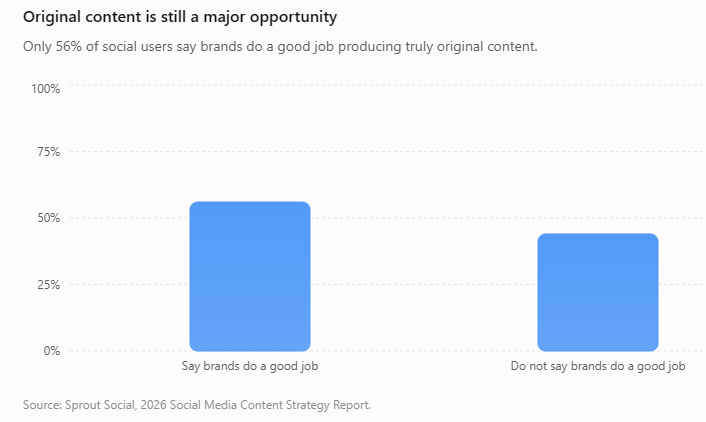
Plus, only 56% of social users believe brands do a good job creating truly original content.
Developing original ideas worth remembering outweighs chasing random trends—and that's a big opportunity for creative professionals who want to stand out!
3. The "Everyone Is My Audience" Trap
Another reason content feels difficult and heavy is that you're trying to talk to everyone.
Maybe you're an artist eager to reach collectors, galleries, museums, and creative organizations.
Or you're an exhibition designer who could technically work with dozens of different types of clients.
So you create broad content that applies to anyone.
The caveat?
When you address everyone, it's harder for the right people to feel understood.
Compare: "5 Marketing Tips for Creatives"
With: "How Independent Artists Can Market Their Work Without Spending Every Evening on Instagram."
The second one immediately targets a specific audience grappling with a clear, relatable problem.
Specificity makes content easier to create because it gives you boundaries and a straightforward path to follow.
So how do you put this in practice?
Start by identifying the people you most want to attract.
Then go deeper than demographics and question:
What are they struggling with?
What have they already tried?
What frustrates them?
What are they afraid of?
What do they wish were easier?
What questions do they repeatedly ask?
What outcome are they hoping to achieve?
Most importantly, think about the problem behind the problem.
Circling back to the previous example, an artist might need help with Instagram, but what they really want is more visibility without spending hours creating content.
That's where your strongest content often lives as you go beyond the surface and offer authentic, in-depth support.
4. The "Consistency Means Constantly Posting" Trap
You've probably heard the advice:
"Consistency is key."
That's true.
But consistency doesn't mean posting daily.
It's about designing a publishing rhythm you can maintain over time.
The risk with the "post more" mentality is that it turns marketing into another full-time job (something I struggled with myself in the past!).
The more pressure you put on yourself to produce, the more likely your content becomes rushed, repetitive, and disconnected from your actual expertise.
Content saturation is extremely high—and posting just for the sake of it isn't enough to capture attention.
If everyone is publishing more, producing more isn't necessarily what will make you stand out.
Meaningful content will!
For one creative business, consistency might mean one inspiring YouTube video every week.
For another, it might mean two compelling LinkedIn posts and one newsletter every week.
For someone else, it could be two thoughtful blog posts a month.
The best schedule is the one YOU can maintain while still having enough energy to do the actual creative work you strive to market.
5. The "AI Will Fix Everything" Trap
And then there's AI, which might feel like an exciting opportunity or intimidating.
Or even one more marketing responsibility you’re expected to figure out.
Whatever the feeling, here’s a crucial distinction to make:
AI can help you create content. But it should never decide what your business stands for.
Your expertise, perspective, experience, voice, and creative judgment are still the most valuable parts of the process.
AI helps you with the heavy lifting, like:
Brainstorming and organizing ideas.
Turning one long-form piece into multiple formats.
Identifying gaps in an outline.
Generating alternative content hooks.
Summarizing research.
Creating good first drafts.
But you should remain the creative director. Always.
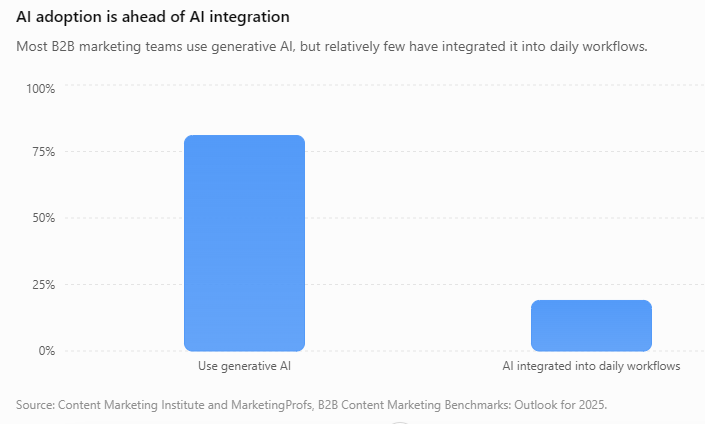
While AI adoption is already widespread, strategic integration is still a challenge.
At least 81% of B2B marketers are consistently using generative AI. Yet many organizations are still experimenting rather than integrating it into their everyday workflows.
My recommended approach?
Don't use AI to replace your thinking, but to amplify it!
This will make AI feel much less intimidating and more beneficial to your marketing strategy.
A Simpler Way to Use AI for Your Content
If you don't know where to start with AI, don't ask it to "write my content."
Start with something you already know.
Give AI a rough collection of your thoughts about a problem your audience faces and ask it to help you identify:
The strongest ideas.
Questions your audience might have.
Potential content angles.
Different ways to explain the same concept.
Related topics worth exploring.
Opportunities to repurpose the idea.
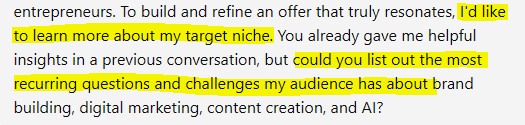
How I prompted AI to dive into my target audience (aka you!)
Then take those insights and bring your own perspective back into the process.
That's where the magic happens:
You keep being the expert, while AI gives you another set of hands for the parts of content creation that don't require your full creative attention.
Want to make AI part of your content workflow?
If you're curious about using AI but don't want your content to sound robotic, generic, or impersonal, I've created a free guide to help: “5 AI-Powered Solutions for Creatives Who Dread Marketing.”
It’ll walk you through practical ways (with proven prompts) to use AI to make marketing easier and stress-free while keeping your expertise and creative voice at the center.
Get the free AI guide here: “5 AI-Powered Solutions for Creatives Who Dread Marketing.”

How to Create Content With More Clarity
Now that we've identified the traps, let's talk about how to create more intentional content.
Start with these four questions:
1. Who am I creating for?
Be specific.
You don't need to exclude everyone else forever, but you should know who you're primarily trying to reach.
2. What problems do they need help solving?
Look for recurring:
Problems.
Questions.
Frustrations.
Desires.
Misconceptions.
Objections.
These become your content raw material to elaborate in depth.
3. What do I want to be known for?
Your content should gradually build associations around your expertise.
If someone encounters ten pieces of your content over six months, what should they think of you? As an expert in what?
That's pivotal to differentiate yourself and get remembered.
4. What does this content need to accomplish?
Not all content needs to sell.
Some content builds awareness.
Some educate.
Some establish expertise.
Some build trust.
Some nurture an existing audience.
Some directly support a sale.
Understanding each piece’s role makes content easier to evaluate.
A social post doesn't have to go viral to be successful.
It might simply need to make the right person think: "This person fully understands my problem."
That's a powerful first step to lasting trust!
How to Stay Consistent Without Burning Out
Once you have clarity around your audience, topics, and goals, the next step is building a sustainable workflow.
Here's a simple approach:
Start with one core idea.
Choose one significant topic your audience cares about.
Develop it deeply.
Turn that idea into your strongest, evergreen content piece—perhaps a YouTube video, blog post, newsletter, or podcast episode.
Extract smaller ideas.
Look for key lessons, questions, stories, examples, opinions, mistakes, and takeaways within the original piece.
Repurpose strategically.
Turn those smaller ideas into content for the channels that actually make sense for your audience.
Repeat.
Instead of constantly starting from zero, you set a durable, solid content ecosystem to return to.
And the best advantage?
AI gains a much more fruitful role, where you use it to transform one thoughtful piece into multiple new assets (no more endless, disconnected post generation!).
From mass-producing average content, you move to a strategic, AI-assisted content plan centered around your true purpose and audience’s needs.
FAQs - Content Marketing for Creatives
How often should creative entrepreneurs post content?
No universal posting frequency guarantees success. The right cadence depends on your audience, your chosen platforms, your goals, and—most importantly—your capacity.
A sustainable schedule you can maintain matters more than an ambitious one you abandon after three weeks.
Stop maximizing the number of posts you publish and stay consistent with delivering meaningful, original content.
What should I post if I have no content ideas?
Start with your audience.
Make a list of the questions existing clients ask you, the problems they encounter, misconceptions you often see in your industry, processes you use, lessons you've learned, and topics you could talk about for hours.
Those are excellent content ideas to take inspiration from, without reinventing something new every time.
Do creatives need to be on social media to grow their business?
Not necessarily. Social media can help amplify your presence, but it's only one part of a broader content marketing ecosystem.
Depending on your business and audience, SEO-focused blogging, YouTube, email marketing, networking, partnerships, speaking, and referrals may all play important roles.
The goal isn't to be everywhere. It's to be discoverable and supportive where your ideal audience is actively looking for help!
Can AI write my content for me?
Sure, it can—with clear guidance.
AI is powerful for brainstorming, outlining, drafting, repurposing, researching, and strategizing. But your expertise and perspective should be at the center of the AI-generated content.
So the strongest workflow is collaborative: You provide the ideas, expertise, and context; AI helps you develop and distribute them more efficiently.
How can I use AI without losing my creative voice?
Give AI your actual ideas, examples, language, opinions, and experiences instead of asking it to invent your expertise from scratch.
Then edit the output.
Challenge it.
Add nuance.
Replace generic language with language you’d use.
And make the final creative decisions yourself. (I use this exact method for all of my content too!).
Your voice isn't something AI should manufacture—so protect it with your unique touch!
What's the difference between content marketing and social media marketing?
Social media marketing focuses on using social platforms to reach and engage an audience.
Content marketing is broader. It includes blog posts, YouTube videos, newsletters, podcasts, web content, social posts, guides, case studies, and other educational material.
For many creative businesses, combining several of these channels creates a more sustainable and profitable system than relying entirely on social media.
You Don't Need More Content—You Need a Clearer System
If you've been feeling stuck with content, I want you to take one thing away from this post:
Your problem isn't that you don't have enough ideas.
It's that you’re creating content without a precise connection between your audience, your expertise, and your business goals.
Once that connection becomes clearer, everything gets easier:
✔️ You know what to talk about because you understand what your audience needs.
✔️ You prioritize the right things because you know what you want to be known for.
✔️ You know where to publish because you've chosen channels intentionally.
✔️ You use AI without sacrificing your voice and creativity.
✔️ You post consistently without turning your business into a content factory.
Instead of acting as an influencer, chasing every trend, posting every day, or creating from scratch, you now have a purposeful content system that’s aligned with you. ♥️
And if that's the part you're struggling to build, my coaching program, “Content Clarity & Flow,” is here to help!
It's designed to help you clarify your positioning and messaging, identify high-impact content pillars, use AI strategically for content creation and repurposing, and build a sustainable marketing workflow you can stick with long-term.
Together, we’ll build a personalized system that strengthens your messaging, saves you time, and attracts the right-fit clients without the overwhelm.