Human-First Content: How to Stand Out When Everyone Uses AI
What happens when everyone has access to the same AI tools? 🤔
The playing field gets faster but also remarkably similar, with polished captions, perfectly structured blog posts, familiar phrases, and generic "actionable tips."
In this repetitive scenario, creating content becomes more than just getting your ideas online.
It's about ensuring people still recognize you behind the words.
For creative entrepreneurs, this is crucial!
Your perspective, experience, values, and creative voice are what make your brand worth following in the first place.
Plus, they’re at the core of authenticity—a competitive advantage for standing out, not a mere “feel-good” marketing concept.
In this post, I'll explore why authenticity matters, what authentic content looks like, the biggest trap creatives fall into when using AI, and how to keep your content aligned with who you are.
This is the final element of my SONYA Framework™—and you can explore the topic further in my companion YouTube video:
Table of Contents
Why Authenticity Matters More Than Ever
Not gonna lie: AI has made it dramatically easier to create content at scale.
Researching, brainstorming, outlining, drafting, editing, and repurposing all happen faster than they used to (AI has revolutionized how I create content too!).
But when everyone produces more content, volume becomes less meaningful as a differentiator.
The question shifts from: "How much content can I create?"
To: "Why would someone want to hear from me?"
That's where authenticity matters!
Trust is a major global issue, and people increasingly evaluate information through the lens of credibility and shared values.
And 78% of consumers expect authenticity and relatability from brands on social media to trust them.
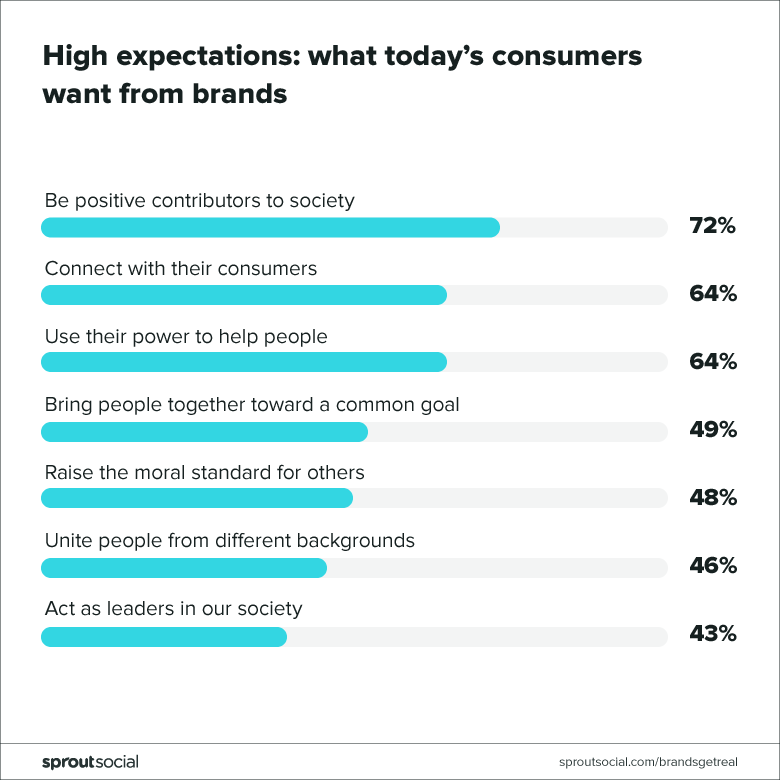
They don’t want brands to be perfect; they want them real.
For creative entrepreneurs, this creates an opportunity that doesn’t involve competing with AI on speed, but rather bringing personal perspective and genuine connection.
What Authentic Content Really Means
Authenticity is misunderstood. (Yes, you read that right.)
It’s not about sharing every personal detail with your audience, refusing to use AI, or writing every sentence from scratch.
Authentic content means there's alignment between what you believe, what you communicate, and how you show up:
It sounds like you.
It reflects your experience.
It represents your values.
It speaks to the audience you want to serve.
And it doesn't make promises you don't believe!
Think about it as a three-way alignment:
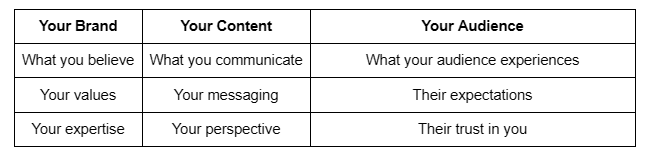
When those three things are aligned, your content becomes coherent and trustworthy.
What Authenticity Is Not
It's equally important to understand what authenticity isn't:
Authenticity doesn't mean oversharing
You can have boundaries.
Your audience doesn't need access to your entire personal life to understand your perspective (after all, you’re a creative business owner, not an influencer!).
Only you decide what's private and what's appropriate for your brand.
So don’t let other peers’ online choices or random, popular trends cloud your judgement.
Authenticity doesn't mean refusing to polish your content
Editing isn't inauthentic.
Neither is improving your writing, restructuring an article, or using AI to catch awkward phrasing.
The question is whether the final content still reflects what you genuinely think and believe.
Authenticity doesn't mean being spontaneous all the time
Strategic content is authentic.
In fact, having an effective content strategy makes it easier to communicate consistently and with impact.
You don’t reinvent your message every time you publish because you have a clear action plan in place.
Authenticity doesn't mean not changing
Authenticity isn't about staying the same forever.
Your perspective, business, and audience can—and will—evolve at different stages.
The goal is to be honest about where you’re now and adapt to your ongoing needs.
The Biggest Authenticity Trap Creatives Fall Into With AI
You may ask AI to create your content because you're overwhelmed.
It gives you something polished.
You make a few quick edits.
And the content is ready for publishing.
Technically, nothing is wrong with it.
But it doesn't sound like you—that’s the common trap to avoid!
Most people use AI as a substitute for thinking rather than as a tool that supports thinking.
The result?
Content that's grammatically sleek but strategically generic, impersonal, and bland.

It may also contain all the "right" information while missing the one thing that makes your brand recognizable:
The generic AI loop
The pattern often looks like this:
"I don't know what to post."
Ask AI for ideas.
Ask AI to write the post.
Make minor edits.
Publish.
Wonder why the content doesn't feel distinctive or engaging.
Repeat.
Sounds familiar?
The problem isn't AI—it’s that your voice entered the process too late.
Start with you first.
Give AI your ideas, experiences, opinions, stories, audience insights, and goals (the more detailed the context, the better the output!).
Then let it help you shape them and optimize the final content with your unique touch.
This guarantees your voice stays front and center at each step of the AI content creation process.
A: Authenticity in the SONYA Framework™
Authenticity is the last component of my SONYA Framework™:
Strategy
Originality
Nuance
Yearning
Authenticity
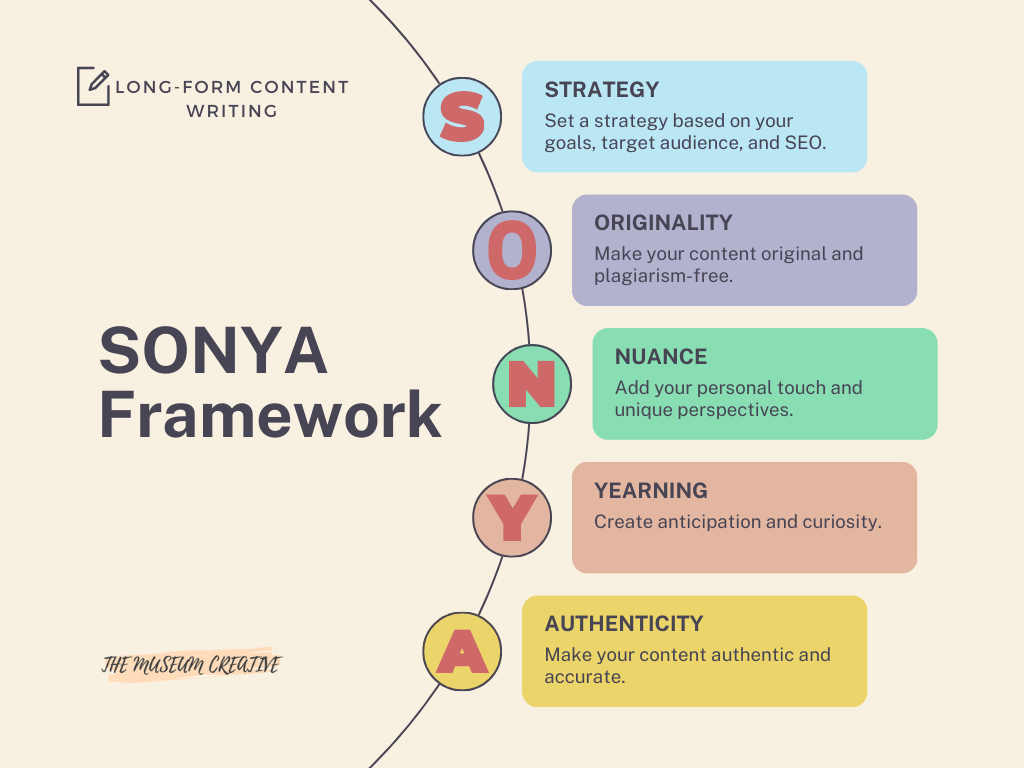
And while it's the final letter, it isn't an afterthought.
Authenticity runs through all five elements:
Strategy asks: “Why am I creating this?”
Originality asks: “What is uniquely mine?”
Nuance asks: “What complexity or context matters?”
Yearning asks: “What transformation can I help my audience envision?”
Authenticity asks: “Does all of this still sound and feel like me?”
That's what brings the framework together.
Let’s see this in practice…
1. Keep Your Perspective at the Center
Before opening an AI tool, spend a few minutes thinking:
What do I actually believe about this topic?
What have I experienced?
What do I disagree with?
What surprised me?
What lesson have I learned the hard way?
What would I tell a client to support their needs?
Write down your answers even if they're messy—those raw thoughts are valuable!
Then, feed them to AI for more meaningful context to work with.
Highlight a point of view near and dear to your mission and goals.
Don’t just tell AI, "Write a blog post about crochet art."
Try something deeper: "Here’s what I believe about crocheting to overcome chronic anxiety based on my experience..."
Then provide your thoughts and actionable solutions to your audience’s problems.
Now AI isn't inventing your perspective.
It's helping you communicate it more impactfully with clear guidance.
2. Give AI Your Voice, Not the Other Way Around
One of the best ways to preserve authenticity is to create a voice reference for your AI workflow.
This could include:
Words you use naturally and those you never use.
Preferred tone and writing style.
Core beliefs and aspirations.
Target audience insights.
Personal and customer stories.
Recurring themes and examples.
Your viewpoint on common industry topics.
The more useful intel you provide (including samples of your best content), the less likely you’re to get generic, robotic content.
A brand voice prompt like this ensures AI understands your brand and consistently generates aligned content!
If AI marketing makes you feel more overwhelmed than empowered, I've created a free guide to help: “5 AI-Powered Solutions for Creatives Who Dread Marketing.”
This resource helps artists, museum professionals, and creative entrepreneurs discover practical ways to use AI for marketing without losing the creativity and human perspective that make their work distinctive.
AI can genuinely make your marketing easier—if you know how to adopt it wisely.
Grab your free copy to get started: “5 AI-Powered Solutions for Creatives Who Dread Marketing.”

3. Use AI to Support Your Thinking—Not Replace It
AI is excellent at helping you move from a blank page to a workable draft.
But don't outsource the parts of the process that require your judgment.
Let AI help with:
Brainstorming.
Outlining.
Repurposing.
Organizing ideas.
Finding potential content gaps.
Summarizing research.
Generating alternative headlines.
Editing for clarity.
Creating first drafts.
But keep ownership of your:
Strategy.
Opinions.
Stories.
Expertise.
Ethical boundaries.
Final decisions.
This distinction matters for designing content where AI serves and boosts your thinking, not replace it.
4. Build an AI Workflow That Reflects Your Values
As part of your marketing strategy, adapting AI to your brand’s rhythm and criteria is key.
What are you comfortable using AI for?
Maybe you love using it for:
Brainstorming.
Researching.
Content outlining.
Repurposing.
Editing.
But not for writing personal stories or producing your final creative concepts.
That's completely valid as you decide the best way to adopt AI.
From there, clarify what requires your direct involvement in the AI workflow and make a list to stick to.
Perhaps your non-negotiables are:
Final messaging.
Personal storytelling.
Artsy direction.
Client relationships.
Sensitive communications.
Brand positioning.
Whatever it is, setting these boundaries makes AI feel less like interfering with your creative flow and more like a tool you’ve incorporated with reason.
5. Be Transparent About Where AI Fits
You don't need to add an AI disclaimer to every social media caption or blog post you publish.
But transparency matters when AI affects your audience’s experience or when disclosure is appropriate for your industry, platforms, offers, or customer relationships.
The European Commission's AI Act framework, for example, includes transparency obligations for certain AI-generated or manipulated content, with requirements becoming applicable in stages.
Even outside regulatory conditions, the broader lesson is to think intentionally about disclosure.
Your audience should be able to trust you're not using AI to misrepresent expertise, fabricate experiences, or create deceptive content.
Simply put, AI should make your communication more efficient without tainting your credibility.
How Authenticity Ties the SONYA Framework™ Together
So why is the SONYA Framework™ so powerful?
Because each component solves a specific content problem:
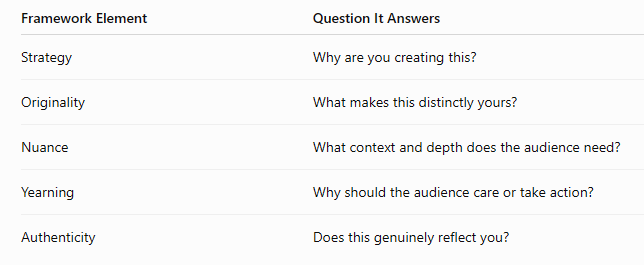
Imagine creating a social post:
Without Strategy, it may be interesting but directionless.
Without Originality, it sounds generic.
Without Nuance, it feels shallow.
Without Yearning, it educates but doesn’t motivate to take action.
Without Authenticity, it looks polished but disconnected.
That's why authenticity ties everything together.
It's the human thread running through the entire content system!
A Human-First AI Content Checklist
Before publishing your next AI-assisted content, ask first:
“Does this content have a clear purpose and audience?”
“Have I contributed an idea, story, perspective, or experience that is genuinely mine?”
“Have I added the context and complexity needed to make this piece helpful?”
“Have I helped my audience understand what's possible or why the outcome matters?”
“Does this sound like me?”
If the answer to the final question is "not really," don't publish it yet.
Go back in.
Add the story, change the language, challenge the generic advice, and tell the reader what you actually think.
That's where the human part begins—so don’t skip it!
FAQs - Authenticity and AI
Can AI-generated content be authentic?
AI-generated content can support authentic communication, but authenticity comes from the human perspective behind the content. Your experiences, opinions, expertise, and editorial judgment need to shape the final result.
Does using AI make my content less authentic?
Not automatically. Using AI for brainstorming, editing, research, or repurposing doesn't make content inauthentic. The problem arises when you let generic AI output replace your own perspective and ingenuity.
How can I make AI content sound more like me?
Start by giving AI your raw ideas, stories, opinions, examples, and audience insights. You can also create a brand voice guide to train AI.
Most importantly, edit the final draft yourself, add your twist, and remove language that doesn't sound natural to you.
Should I tell my audience when I use AI?
It depends on how you're using it, your industry, your audience’s expectations, and applicable rules or platform policies.
Transparency is essential when AI changes what your audience receives or when disclosure is legally or ethically required.
What should creatives avoid using AI for?
There’s no universal answer, but many creatives keep AI away from areas that depend heavily on personal experience, artistic authorship, sensitive client relationships, or original creative direction.
The key is to establish your own boundaries and implement AI accordingly.
How does authenticity fit into the SONYA Framework™?
Authenticity is the fifth and final element of my SONYA Framework™. It ensures that strategy, originality, nuance, and yearning remain grounded in your actual voice, values, experience, and perspective. It’s what turns the framework from a vague content formula into a thoughtful, human-first marketing system.
Human Perspective Is Your Competitive Advantage
AI doesn’t make human creativity less valuable. (Not from my experience, at least.)
In many ways, it makes it easier to see how priceless it’s always been.
When anyone can generate a polished introduction, brainstorm 50 headlines, or produce a perfectly formatted listicle in seconds, those things become indistinct.
What remains difficult to replicate, though, is your lived experience, with your perspective, wisdom, values, and vision of the world.
That's the part of your brand worth protecting!
So don't think of authenticity as something to add to AI-generated content only at the end.
Build it into your content creation process from the beginning:
Think first.
Share your perspective.
Use AI strategically.
Question its suggestions.
Add your stories.
Protect your boundaries.
And call the last shots about what represents your brand.
Because the ultimate goal is to deliver content that makes your audience glad they finally found YOU. 😉
Ready to build a human-first marketing strategy with AI?
If you're ready to simplify your marketing, use AI more strategically, and create content that sounds like you, my coaching, “Content Clarity & Flow,” is here to help!
This personalized program is designed for creative entrepreneurs who want clarity around what to say, how to say it, and where AI can genuinely support their marketing—without losing the human perspective that makes their brand unique.
Together, we'll create an AI-assisted marketing approach that fits your goals, your creative business, your audience, and your capacity.
You don't need to choose between efficiency and authenticity; you can have both.
And staying unmistakably human may be one of the smartest marketing decisions you can make today.
Explore the full program to get started: “Content Clarity & Flow.”