Do you ever feel like your creative business has become a content machine?
You wake up thinking about what to post, check what's trending, try to come up with another reel…
Then you realize you haven't posted on LinkedIn in a few days.
You still need to write your newsletter.
Your blog is sitting half-finished.
And somewhere in the back of your mind, there's a nagging feeling that everyone else is doing more than you.
So you push yourself to create another piece of content.
Then another, and another.
Until marketing takes up so much mental space that you have little left for the creative work you're actually trying to build your business around.
Sounds familiar?
The good news is you're not failing at marketing; your content system may simply be unsustainable.
Social media burnout isn't just about spending too much time scrolling.
The pressure comes from the constant expectation to produce, publish, monitor, adapt, and stay visible.
And when your entire content strategy depends on creating something new every time you post, burnout becomes inevitable.
In this article, I'll break down why content creation exhausts creative entrepreneurs and walk you through the sustainable content system I teach inside my coaching—one built around content pillars, repurposing, smart planning, and AI-supported workflows.
The goal isn't to disappear from the internet, but to show up online without sacrificing your creative energy (and mental health!).
Let’s dive in!
🎥 Prefer to watch? I explore this topic in my YouTube video as well:
Table of Contents
Why Social Media Burnout Happens to Creative Entrepreneurs
Let's start with a key concept:
Social media burnout isn't a personal failure.
There's a structural problem built into the way social platforms work.
They're designed around continuous activity, with always another trend, another format, another algorithm update, another platform feature, and another trick telling you to post three times a day.

And because social media is tied to visibility—and potentially income—it gets hard to ignore all of it.
For a creative entrepreneur, this generates an exhausting cycle:
Create → publish → monitor → compare → worry → create again.
There's very little sense of completion.
The moment you finish one post, you're back to thinking about the next one.
It’s a never-ending loop.
Research confirms this problem, showing how constant connectivity and the demands of an "always-on" digital work environment contribute to burnout among social media marketers.
This isn't limited to people working in the social media field, though.
Content creators report burnout, anxiety, depression, chronic pain, and other mental-health concerns due to prolonged work hours, continuous connectivity, and persistent content creation,
Perhaps most strikingly, 52% of creators have experienced burnout as a direct result of their creator careers, while 37% have considered leaving the industry.
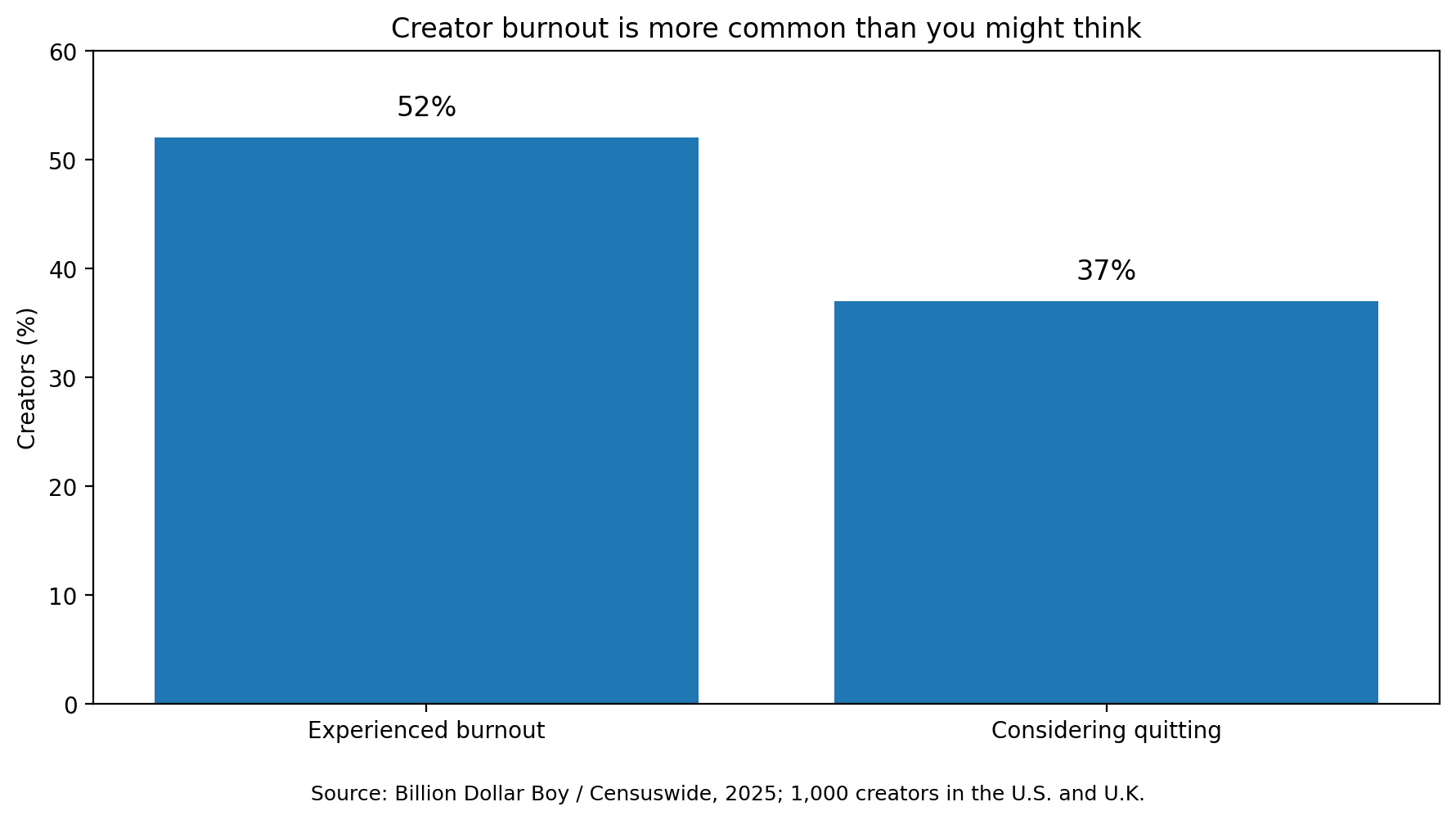
The always-on content model has a sustainability problem. No doubt.
So don't wait until you're completely burned out to change yours!
The Real Problem Behind Content Fatigue
It's tempting to think that having too much content to create is the reason for content fatigue.
Yet, the deeper problem is how you're creating it.
Consider two arts entrepreneurs.
The first wakes up every Monday asking, "What should I post this week?"
They open Instagram, scroll through their feed, see a trend, try to adapt it, and remember they haven't posted about their offer recently.
So they make a promotional post.
Then they realize they need something educational, so they record a reel.
Then they think about something personal, so they publish a story.
By Friday, they're exhausted and hope their spur-of-the-moment content will stick.
The second entrepreneur works from a clear system instead.
They know their three or four core content pillars, have a list of burning audience questions, and a library of targeted ideas.
They create one substantial post around a topic; then turn that idea into several smaller pieces.
They know where each piece will be published and don't have to reinvent their strategy every Monday.
Which one sounds more sustainable?
The second one, obviously.
But there's another important difference: The second entrepreneur has removed dozens of decisions from their week.
Because decision fatigue matters!
When marketing requires you to constantly choose…
What to talk about.
Where and when to post.
What format to use.
How to phrase content.
Whether to make a video or follow a new trend.
…It consumes much more mental energy than the actual number of posts would suggest.
That's why sustainable content isn't about doing less, but rather making fewer strategic decisions that support your entire workflow.
Why Creating Everything From Scratch Is Exhausting
One of the biggest content mistakes I see creative entrepreneurs make?
They treat each content piece as a completely new creative project.
A new social post, newsletter, video, or blog always starts from zero.
Suddenly, you're expected to generate dozens of original ideas every month—no wonder you're tired!
But here's a better approach:
Quit coming up with constant new ideas and start extracting more value from those few that already exist.
One strong idea can become an entire content ecosystem.
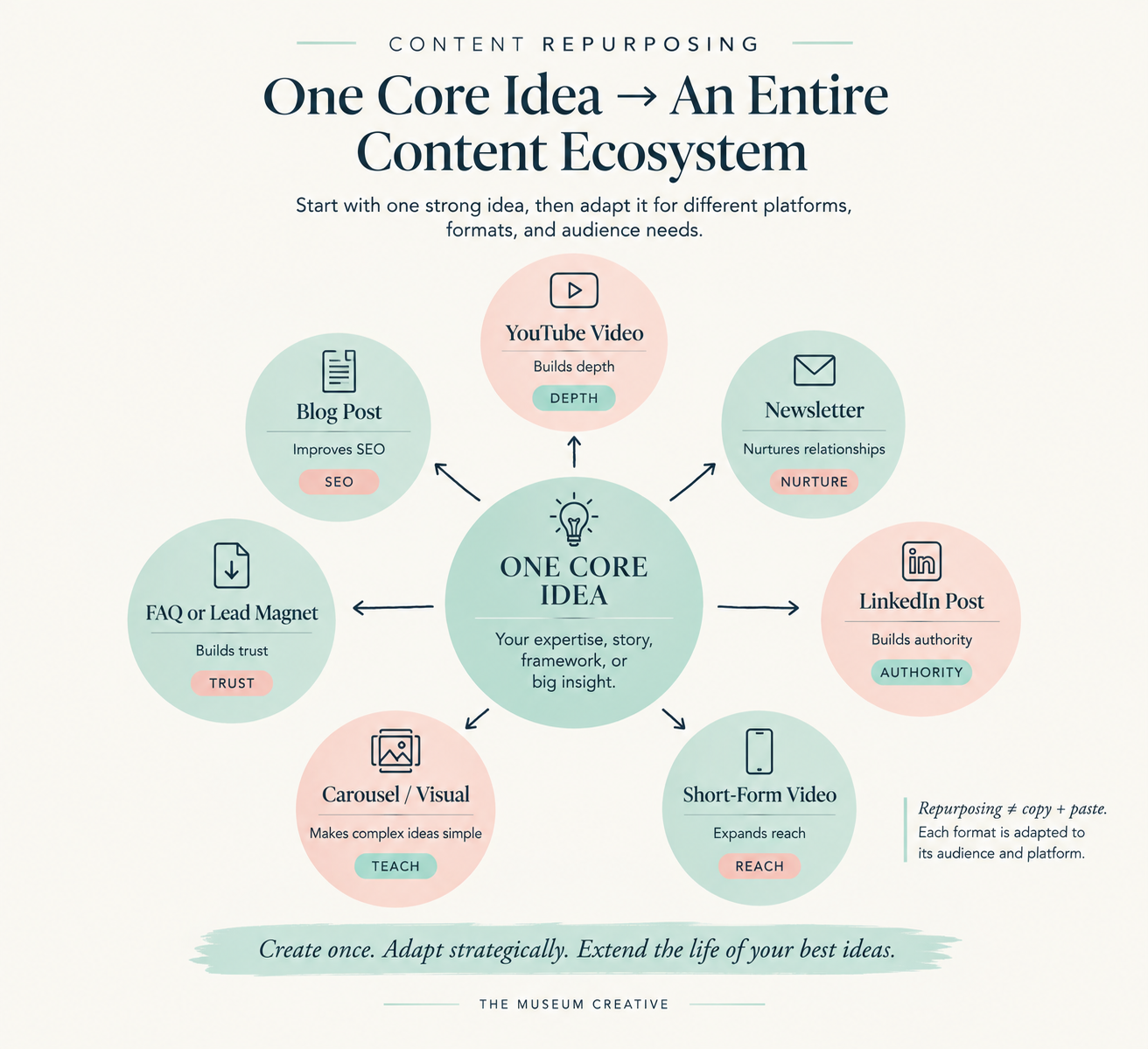
Let’s say my core topic idea is: "You don't need to post every day to grow your creative business."
That could become:
YouTube video: “Why posting every day isn't the answer.”
Blog post: “The sustainable content strategy for busy creatives.”
Newsletter: “What I learned from stopping the daily posting cycle.
LinkedIn post: “The uncomfortable truth about content consistency.”
Carousel: “5 signs your content strategy is unsustainable.”
Short video: “You don't have a content problem. You have a system problem.”
Story: “Behind the scenes of my weekly content workflow.”
That's not seven individual ideas.
It's one idea explored from seven useful angles.
Which represents the foundation of sustainable content creation.
The Sustainable Content System I Recommend
The system I teach inside my coaching is built around a simple principle:
Create once. Repurpose strategically. Distribute intentionally. Learn from the response.
Here's what that looks like:
Choose your core topics → Your content pillars.
Create one strong piece of content → Your "source" or cornerstone content.
Extract smaller ideas → Posts, emails, videos, tips, quotes, FAQs, examples.
Distribute across your priority channels → Without trying to be everywhere.
Review what resonates → Use audience feedback and performance data.
Feed those insights back into your strategy → Better ideas next time.
This builds a stress-free flywheel that beats content creation overwhelm:
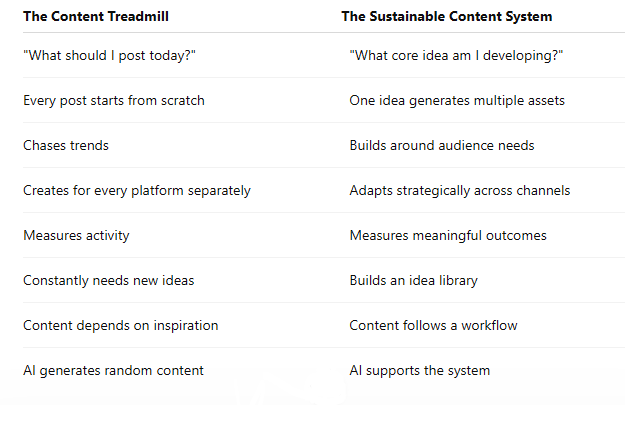
Powerful difference, right?
And it's why content repurposing deserves much more attention than it gets (so don’t overlook it!).
The Power of Content Pillars
Content pillars are the recurring themes your brand talks about based on your target niche, your goals, and “the territories” you want to be known for.
For example, for The Museum Creative, my content pillars revolve around ideas like:
Content strategy for creatives: How to plan, structure, and simplify content marketing.
AI-assisted marketing: How creative entrepreneurs can use AI without losing their voice.
Sustainable marketing: How to grow visibility without relying on constant social media activity.
Creative business growth: How content builds trust, authority, and opportunities.
These pillars make content creation way easier.
Instead of staring at a blank page, you start with clear boundaries that move you from “What could I possibly talk about?" to "What does my audience need to know about this topic?"
That's a much more productive question that reduces overwhelm.
Imagine having four content pillars and five audience questions under each one.
That's already 20 potential topics, each generating:
One educational post.
One personal story.
One practical tip.
One FAQ.
One industry angle.
You've suddenly created a prospective library of 100 pieces of content without inventing 100 unrelated ideas.
That's the power of a system!
You don’t manufacture ideas. You build on them.
How Repurposing Changes Everything
Let's clear up a misconception about repurposing.
Repurposing doesn't mean copying and pasting the exact same post everywhere.
Good repurposing means taking one valuable idea and adapting it to the context of another channel.
For example:
A YouTube video is conversational and detailed.
A blog post expands the argument with research and examples.
A newsletter tells the personal story behind that idea.
A LinkedIn post pulls out the strongest insight.
An Instagram carousel turns the framework into a visual.
A short-form video answers one specific, related question.
The idea stays consistent.
The format changes.
The audience context adapts.
The purpose amplifies.
This way, you get more mileage and better results from the work you've done.
Here’s a simple repurposing map to make existing content work harder:
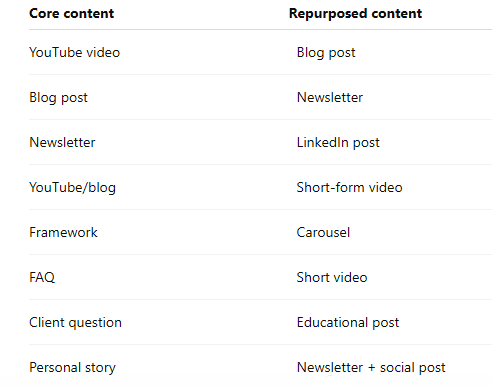
You could also reverse the process: A client question becomes a social post; that post turns into a video; then the video becomes a blog, and so on.
The possibilities are endless—and finally you stop treating every content asset as an isolated, random task!
Where AI Fits Into This Sustainable Workflow
This is where AI makes a huge difference, but only if you use it to support a system that makes sense.
AI isn't your content strategy, nor should it become another source of overwhelm.
Instead of spending hours learning complicated prompting techniques just to produce 50 social posts nobody asked for, use AI where it genuinely saves you time.
Use AI for idea expansion
Give AI one strong topic and ask it to help you explore:
Different audience pain points or recurring questions.
Contrarian angles.
Examples.
Stories.
FAQs.
Different content formats.
You're not asking it to invent your expertise, but to see more possibilities inside an idea you already understand.
Use AI for repurposing
This is one of my favorite applications.
Give AI a finished YouTube script or blog post and ask it to identify:
Three newsletter angles.
Five LinkedIn post ideas.
Five short-form video hooks.
Three FAQs.
A concise framework.
Key quotes or insights.
Then review and refine the output yourself.
You won’t publish everything AI generates, but this approach will dramatically reduce the amount of blank-page work you have to do.
Use AI for content optimization
AI can also help:
Clarify headlines.
Improve structure.
Identify repetition.
Suggest SEO opportunities.
Create meta descriptions.
Turn long explanations into concise summaries.
Find questions your posts should answer.
Many workflow benefits come from it.
Thanks to generative AI, 51% of marketers reported fewer tedious tasks, 45% more efficient workflows, 42% improved content optimization, and 38% boosted creativity.
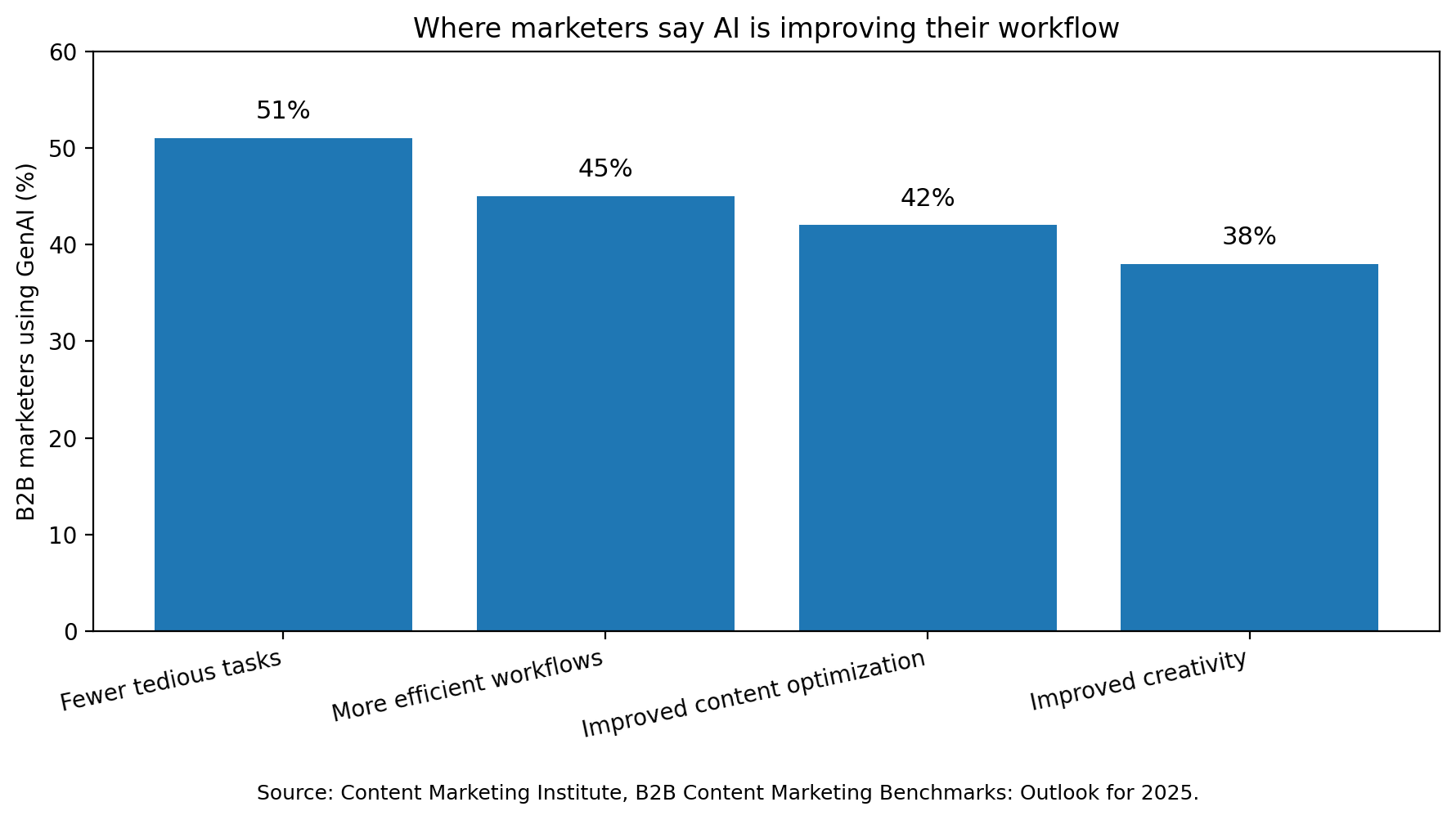
Best of all, 82% of creators who frequently experience creative fatigue said AI helps them overcome it.
That’s impressive!
AI can surely reduce production friction, but it can't replace strategic thinking.
You still need to decide:
Who you're talking to.
What you want to be known for.
What your audience needs.
What your business is trying to achieve.
What deserves your attention and what doesn't.
That's your job.
AI assists you in executing it more efficiently!
Want to make AI work for your marketing without adding more complexity?
If you're eager to use AI to make content creation easier and less stressful—but don't want to lose your creative voice—I've created a free guide for you.
“5 AI-Powered Solutions for Creatives Who Dread Marketing” walks you through practical ways to adopt AI as a creative partner for content planning, idea generation, writing, and more.
Get your free copy here: “5 AI-Powered Solutions for Creatives Who Dread Marketing”

A Simple Weekly Workflow for Creative Entrepreneurs
You don't need to spend every day thinking about content.
In fact, I recommend separating content planning from content creation.
It might look like this:
Monday: Plan
Spend 30–60 minutes reviewing your content pillars, audience questions, business goals, and existing ideas.
Choose one core topic.
That's it.
Tuesday: Create
Create your cornerstone content: A YouTube video, blog post, newsletter, or another substantial piece that contains enough ideas to repurpose.
Wednesday: Repurpose
Extract smaller pieces from the core content.
Use AI if it helps you move faster.
Then add your own perspective, examples, personality, and edits.
Thursday: Distribute
Schedule or publish your planned content across your go-to channels.
You won’t need to create something new for every platform this way.
Friday: Connect and review
Respond to comments, reply to emails, notice what people engaged with or what questions came up, record new ideas, and then step away.
Your content strategy will keep working for you:
Plan → Create → Repurpose → Distribute → Review → Rest (yes, this last step is also important!)
And remember: You don't need to be everywhere
The main cause of social media exhaustion is trying to maintain a presence on every platform—which turns content marketing into a second full-time job.
Your audience isn't everywhere. And you don't need to be either.
Rather than obsessing over which platforms to be on, ask yourself:
"Where can I consistently reach the people I want to work with?"
“Where are they actively looking for help?”
“Where can I maintain a consistent presence”
Then build your system around the best-fit channels.
Your Sustainable Content System at a Glance
Here's the whole approach in a nutshell:
1. Choose your pillars
Know the subjects you want to be known for.
↓
2. Create one strong core piece
Give yourself something substantial to work from.
↓
3. Repurpose strategically
Extract smaller ideas instead of starting from zero.
↓
4. Distribute intentionally
Focus on the platforms and channels that matter.
↓
5. Use AI where it saves time
Brainstorm, organize, repurpose, optimize, analyze.
↓
6. Measure and learn
Pay attention to what your audience responds to.
↓
7. Rest and repeat
Let the system do the heavy lifting—and keep growing!
FAQs - Sustainable Content
How do I know if I'm experiencing social media burnout?
There isn't one universal definition, but common warning signs include feeling behind, losing enthusiasm for creating content, obsessing over performance, struggling to switch off from platforms, procrastinating because content feels overwhelming, or feeling like marketing is consuming energy you need for your actual creative work.
If content creation leaves you feeling depleted (I’ve been in the same boat too!), it's worth looking at your system—not just your productivity.
Do I need to post every day to grow my creative business?
Not at all—there’s no universal posting frequency that guarantees growth.
A sustainable strategy is more valuable than an aggressive schedule you can't maintain.
Your goal should be to find a realistic cadence that gives your audience enough opportunities to encounter your work while leaving enough energy for your creative work and the rest of your business.
What are content pillars?
Content pillars are those 3-4 recurring themes or subject areas your brand consistently creates content around.
They help you avoid starting from a blank page every time you need an idea.
A good set of pillars should overlap between three things:
What your audience cares about.
What you know or want to be known for.
What connects naturally to your business.
How often should I repurpose content?
There's no fixed number.
A better question is: How much value can you extract from a strong idea without becoming repetitive?
One YouTube video might become a blog, newsletter, several social posts, a short video, and an FAQ.
Another topic might only need two or three adaptations.
Quality and relevance matter more than hitting a repurposing quota.
Won't people get tired of seeing the same content?
Not necessarily—your audience doesn’t see everything you publish.
Different people discover your content at different times and on different platforms.
And even when someone has seen an idea before, presenting it in a new context can make it more useful.
The key is to adapt rather than duplicate.
How can AI help me avoid content burnout?
Use AI to reduce repetitive work, not to replace your creative thinking.
Ask it to brainstorm from your content pillars, expand ideas, repurpose existing material, summarize research, improve structure, generate variations, or analyze content performance.
The most helpful AI workflow is one that gives you back time and mental energy!
Should I quit social media if it's burning me out?
You don't have to choose between "be everywhere" and "leave social media forever."
You can reduce your platform mix, post less frequently, build more evergreen content, prioritize email or your website, repurpose your best ideas, and create boundaries around when you engage.
The ultimate goal is to make marketing sustainable, so evaluate what works best for you.
What if I don't have enough time to build a content system?
Start small:
Choose three content pillars.
Create 1-2 strong pieces of content each week.
Repurpose it into two or three smaller pieces.
Keep an idea bank or content calendar with your targeted topics.
Review what works once a month and refine.
That's already an efficient, repeatable system that doesn’t require complicated steps or multiple decisions.
You Don't Need to Create More. You Need a Better System.
For a long time, I thought I needed “more time” to market my business.
More time to write, post, come up with ideas, keep up with social media…
But eventually I realized time wasn't the real problem.
My system was!
When every content piece required a completely new idea, when I measured success by how often I posted, or when I treated every trend like an obligation, marketing became exhausting.
The solution wasn't to be more productive at an unmanageable process.
It was to build a better one.
That's what a sustainable content system gives you:
Your ideas have a clearer direction.
Posting has a deeper purpose.
Your best content has a longer life.
AI plays a more useful role.
And, perhaps most importantly, it frees you from the content creation hamster wheel.
Your business needs your creativity.
So don't spend all of it trying to feed the content machine.
Build a system that protects your creative energy instead! 😉
Not sure where to start?
My coaching program “Content Clarity & Flow” could be the solution you’ve been looking for!
It’s designed to help visual artists and independent museum professionals simplify their marketing, save time with strategic, AI-assisted content creation, and build a sustainable workflow that supports growth without taking over their creative lives.
If you’re tired of figuring things out alone, it’s time to change that.