The Missing Ingredient That Makes Content Feel Human (Especially With AI)
Have you ever read something that was technically perfect but somehow felt… empty? 😬
The sentences were polished; the information was accurate; maybe the headline was even compelling.
But something was missing…
There was no tension, no context, no personality, no sense that a real person had actually lived through what they were talking about.
That missing ingredient is nuance.
For creative entrepreneurs, nuance is what turns information into insight.
It's what helps your audience understand not only what you know, but how you think, what you've experienced, and why your perspective matters.
With AI becoming a bigger part of content creation, nuance is crucial to building true connection.
And in today’s post, I’ll show you how to use it to make your content impactful and memorable
If you'd like to explore this topic further, watch my companion YouTube video, where I dive deeper into how nuance can transform AI-assisted content:
Table of Contents
Why Content Without Nuance Feels Empty
There's nothing inherently wrong with straightforward content.
Sometimes your audience needs a quick answer.
But when every idea is reduced to a simple formula, something important gets lost.
Consider the difference between: "Artists should post consistently to grow their audience."
And: "Consistency matters, but I've found that asking an artist who already feels overwhelmed to post every day creates the opposite of what they need. A sustainable rhythm that leaves room for the actual creative work is far more effective."
The first statement is advice.
But the second gives context through personal experience and deep thinking.
It acknowledges that consistency isn’t an absolute rule and the "right" strategy depends on the person, their resources, and their goals.
That's nuance!

Trust relies heavily on credibility and the quality of information people receive.
That’s where nuance comes in to strengthen credibility—showing you're not merely repeating convenient answers; you're thinking critically about the subject.
With it, you give “color” to otherwise bland, generic content.
What Is Nuance in Content Marketing?
Nuance is the ability to recognize that most significant questions don't have one universal answer.
It means adding…
Context
Exceptions
Contrasting perspectives
Real-world examples
Emotional awareness
Personal experience
Complexity
Appropriate qualifications
…To make your writing accurate and valuable enough to reflect reality.
In my content, for example, I could say: "AI saves creatives time."
But, instead, I opt for a more nuanced and personal messaging: "AI can save creatives significant time when it's used for repetitive or preparatory tasks, but it can also create more editing work if you rely on generic outputs that don't reflect your voice. Do this instead…"
I give my audience (aka you!) a more complete picture based on my unique perspective and experience.
And that’s what makes content stand out!
How AI Can Flatten Meaning
AI is incredibly good at producing clear, organized, readable content.
But that’s not all…
If you ask it a broad question, you'll get an answer that overall:
Sounds confident.
Uses familiar language.
Organizes everything into tidy categories.
Presents recommendations as broadly applicable.
Avoids ambiguity.
This is useful for a first draft.
Yet, real life isn't always neat.
Creative careers aren't linear.
Growing your art brand isn't one-size-fits-all.
Your audience isn't a collection of identical people.
And your experiences don't fit perfectly into a template.
That's why blindly publishing straight-out-of-AI content results in something polished but disconnected; sleek but average.
The information isn’t wrong per se, but the meaning has been flattened (which also explains why most AI content sounds robotic!).
N: Nuance in the SONYA Framework™
Nuance is the third component of my SONYA Framework™:
Strategy
Originality
Nuance
Yearning
Authenticity

Strategy gives content direction.
Originality gives it distinction.
Nuance gives it depth.
It's the extra layer that asks:
"But what about...?"
"What if the situation is different?"
"What's the other side of the coin?"
"When might this advice not work?"
Similar questions are invaluable because they prove thoughtfulness.
And thoughtful content is much harder to mistake for generic content.
Let’s see this in practice…
1. Add Context to Your Ideas
One of the easiest ways to add nuance is to explain the circumstances surrounding your advice.
"Email marketing is important" isn’t sufficient to support the audience’s specific needs.
Try something deeper: "Email marketing is especially beneficial for creative entrepreneurs because it gives you a direct way to nurture relationships outside social media algorithms. But building an email list is a long-term investment, so it works best when you have a clear reason for people to subscribe." (True advice btw!)
The second version gives the reader more to work with.
It explains what to do, when to use email marketing, and why it matters.
So before publishing any content, ask yourself:
"What context (and personal story) would help my reader apply this advice correctly?"
2. Acknowledge Complexity
When examining a key topic in your niche, don't be afraid to say: "It depends."
That's not weakness—sometimes it's the most honest answer you could give.
Take it from me.
Creatives always ask me which social channel they should target for wide visibility. But the truth is there isn't a perfect social media platform for everyone.
The best one depends on:
Your audience.
Your content format.
Your goals.
Your capacity.
Your industry.
Your strengths.
Acknowledging those variables makes your advice more useful and trustworthy!
It also makes you sound like a human being who understands reality and shares a genuine perspective rather than delivering a rigid formula.
That’s what builds lasting impact!
Are you using AI for content creation but worried about losing your voice or creating content that feels generic?
My free guide can help: “5 AI-Powered Solutions for Creatives Who Dread Marketing.”
Inside, you'll discover practical ways to use AI as a creative partner (not a replacement!) while keeping your perspective, personality, and expertise at the center of your marketing.
It's designed for artists, museum professionals, and creative entrepreneurs who want to save time without sacrificing the human element that makes their work meaningful.
Grab your free copy here: “5 AI-Powered Solutions for Creatives Who Dread Marketing.”

3. Share What You've Learned Through Experience
Another strong source of nuance is lived experience.
Don’t simply tell your audience what to do; explain what happened when you tried it and why it’s important.
Tell them:
What worked.
What didn't.
What surprised you.
What you would change.
What you learned.
When I talk about marketing overwhelm and how to overcome it, I often refer back to my personal story because it’s relatable and honest:
"I used to believe posting more content would solve my visibility problem. What I eventually discovered was that publishing more wasn't the answer—I needed a clearer understanding of who I was trying to reach and how to show up more sustainably."
Notice how this sentence contains a lesson, but also offers context and transformation?
Your experience gives your advice weight—and nuance!
4. Add Emotional Intelligence
Nuance isn't only intellectual. It's emotional.
Your content should bring feelings to your audience.

An artist reading about marketing may already be intimidated.
A museum professional may feel pressure to keep up with digital trends.
A creative entrepreneur may feel guilty about not posting consistently.
If my advice ignored those emotions, it’d easily sound detached—no matter the quality of the information.
So I don’t limit myself to: "You need to post more consistently."
I go beyond that: "If you're already overwhelmed by marketing, adding another daily posting requirement probably isn't going to help. Start with a content rhythm you can realistically maintain."
Same basic topic.
Completely different emotional experience.
That distinction is emotional intelligence—and it’s what your content should never miss!
5. Challenge the Obvious Answer
Nuance often begins when you question conventional wisdom.
Ask yourself:
Is this advice always true?
What might people be overlooking?
When does this approach stop working?
What's the unintended consequence?
What would I tell someone who can't follow the standard advice?
These questions uncover your most interesting content ideas.
Plus, they position you as a thoughtful authority rather than someone aimlessly repeating industry talking points.
Why Nuance Builds Trust and Authority
Anyone can repeat information.
But authority comes from showing that you profoundly understand the subject and can explain its complexity.
Thought leadership helps businesses build credibility and influences buying decisions through valuable expertise and perspectives that go beyond simple product or service promotion.
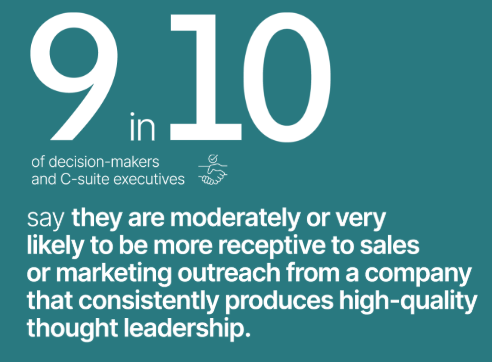
Nuance strengthens that kind of thought leadership.
By explaining exceptions, acknowledging trade-offs, and sharing lessons from experience, you give your audience an immediate reason to think:
"They know the topic—and understand what it actually looks like in the real world!"
“They know how it feels!”
This authentic connection generates authority.
How to Humanize AI-Assisted Content
If AI helps you draft an article, don't proofread it and call it a day.
Here are five ways to do so:
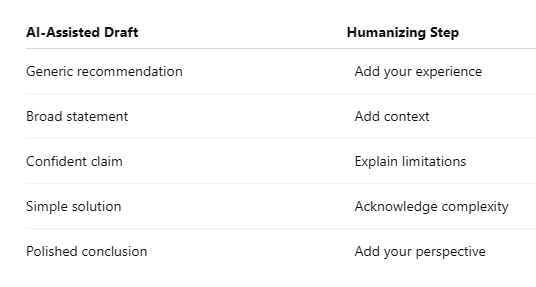
You could even ask AI to help you identify where nuance is missing with prompts like:
"What assumptions does this article make?"
"Where could this advice be too broad?"
"What important exceptions should I acknowledge?"
"What questions might a skeptical reader ask?"
"Where in the content could I add a real-world example?"
"What emotional concerns might my audience have about this topic?"
Then don't blindly accept the answers.
Challenge them and use them as inspiration for your own thinking.
That's the difference between requesting AI to make your content “human” and using it to help you make it more human yourself!
A Simple Nuance Checklist
Before publishing your next content piece, revisit these questions for more nuance:
Have I provided enough context?
Have I acknowledged relevant exceptions?
Did I include a personal experience, client story, or example?
Have I considered how my audience might feel?
Did I challenge at least one assumption?
Does my advice reflect real-world complexity?
If AI helped me draft this, did I add meaningful human perspective?
If the answer is “yes,” well done—your content is carrying more depth than a generic AI-generated draft!
FAQ - Nuance and AI Content
What does nuance mean in content creation?
Nuance means adding context, complexity, experience, and perspective to an idea rather than presenting it as a simple universal answer. It helps readers understand when advice applies, when it may not, and why.
Why does AI-generated content often lack nuance?
AI systems are designed to generate useful responses based on patterns in their training and instructions. Without specific context or human editing, their responses default to broad, generalized recommendations. Human experience and judgment are needed to add the details and perspectives that make content feel grounded.
Does adding nuance make content harder to read?
Not necessarily. Good nuance makes content more helpful without making it complicated. The goal isn't to add jargon or endless caveats. It's to provide the context readers need to understand and apply your ideas.
How can I add more nuance to my content?
Start by sharing your experience, acknowledging exceptions, adding context, telling supporting stories, and considering alternative perspectives. Also, question where a recommendation might not work and what your audience needs to know before applying it.
Does nuance help build authority?
Yes. Nuance proves that you understand a topic beyond surface-level information.
When you explain trade-offs, recognize complexity, and connect advice to real-world experience, readers have more reason to trust your expertise and connect with you.
How does nuance fit into the SONYA Framework™?
Nuance is the third element of my SONYA Framework™, following Strategy and Originality. Strategy establishes purpose; Originality adds your distinctive perspective; and Nuance gives your content depth and context.
Together, they create content that is more thoughtful, memorable, and useful.
Your Audience Doesn't Need More Information—They Need More Meaning
Information is everywhere.
AI summarizes an entire topic in seconds.
Search engines surface thousands of articles.
Social media gives you endless tips and opinions.
So your advantage for standing out isn't delivering more information.
It's knowing what that information means in context and perspective.
That's what nuance brings to your content.
It lets you say, "Here's what I've learned—and here's where things get interesting."
It gives your audience permission to see themselves in the advice you're sharing.
And it reminds them there's a real person behind the words.
As AI changes content creation, that human layer only becomes more valuable.
Your experiences, emotional intelligence, critical thinking, and ability to recognize complexity aren’t obstacles to efficient content creation—they're what make your content worth reading!
Use nuance, and you’ll make your content matter for the long haul. 😉
Ready to create more human, strategic content?
If you want to use AI to simplify your marketing without losing the depth, personality, and perspective that make your creative brand unique, my coaching program, “Content Clarity & Flow,” is here to help!
Together, we'll create a personalized, AI-assisted marketing strategy that clarifies your message, streamlines your content workflow, and helps you create content that sounds like you—not like a machine.
You'll gain the clarity to know what to say, the strategy to know why you're saying it, and the confidence to use AI as a strategic co-creator while keeping your humanity at the center.
If you’re ready, explore the full program here: “Content Clarity & Flow.”